A database needs its data to outlast a Pod. Rather than naming a cloud disk in the Pod, create a PersistentVolumeClaim (PVC) that requests storage in platform-independent terms. The Pod references the claim; Kubernetes finds or creates a PersistentVolume (PV) representing suitable storage and binds the two. This lets the workload run wherever persistent storage is supported. section 9.1.2
Figure 9.2 A Pod that references a PersistentVolumeClaim that gets bound to a PersistentVolume, which references a disk
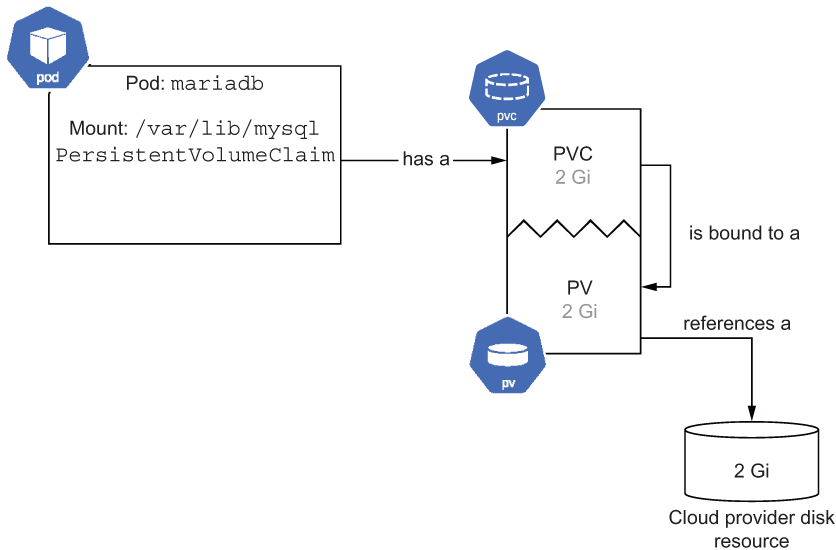
Follow the references from Pod to claim, from bound claim to PersistentVolume, and from PersistentVolume to disk. section 9.1.2
A claim specifies how much storage the workload needs and how it must be accessed:
- Request a capacity, such as 2 GiB for a MariaDB database. section 9.1.2
- Choose an access mode. ReadWriteOnce suits the single-Pod database example; ReadOnlyMany permits sharing existing data for reading, while ReadWriteMany permits multiple Pods to read and write where supported. section 9.1.2
- Mount the named claim in the container. For MariaDB, the mount path is /var/lib/mysql. section 9.1.2
Check that a database claim is bound
Create the MariaDB Pod and PVC, then inspect the claim with kubectl get -o yaml pvc/mariadb-pv-claim. A successful example shows phase: Bound, capacity: 2Gi, and a volumeName identifying its PV. Inspecting that PV shows a claimRef pointing back to the PVC. The Pod uses the claim name, not the cloud disk identifier. section 9.1.2
A StorageClass determines what kind of storage is dynamically provisioned and how it is handled later. Check its reclaim policy before storing important data: with Delete, deleting a bound PVC also deletes its PV and backing disk; with Retain, the disk remains available for deliberate recovery, but unwanted disks must be removed manually. Deleting a StatefulSet alone does not delete its PVCs. section 9.1.3 section 9.3
For one database Pod, a Deployment can reference a standalone PVC and recreate a terminated Pod. Do not extend that arrangement to replicas that each need their own disk: they would reference the same claim. A StatefulSet instead uses volumeClaimTemplates to create a distinct PVC for each Pod, tied to that Pod’s stable identifier. section 9.1.4 section 9.2
If a disk was retained after its Kubernetes objects were removed, recovery involves recreating and relinking the PV and PVC before bringing the workload back. Retain must be in place before deleting claims whose data matters. section 9.3








