A perspective is a particular viewpoint for considering a problem, subject, or set of information. Complex business problems often become clearer when people model them from several perspectives rather than forcing one tool to represent everything. Each collaborative modeling tool highlights particular needs while leaving other details in the background. section 2.3
Choosing a route to the Rijksmuseum
A metro map can show a route from Bijlmer Arena to Vijzelgracht, but it does not show the museum’s distance from the station or alternative transport. A cycling map, walking information, or driving route reveals different possibilities. Comparing these maps exposes trade-offs involving time, cost, and convenience; combining them supports a better decision than relying on one map. section 2.3
Different perspectives also reveal disagreement and assumptions. Sensemaking exercises help groups notice hidden tensions, make minority perspectives visible, and challenge their own interpretations. They can turn an unproductive discussion into an explicit choice about whether to continue modeling or move toward coding. section 4.3.4
Use perspectives deliberately during collaborative work:
- Select a modeling tool that addresses the question at hand instead of treating any tool as a complete solution. section 2.3
- Compare models to expose options and trade-offs that a single representation conceals. section 2.3
- When shadows seem to block progress, run a sensemaking exercise and let the group test the resulting interpretation. section 4.3.4
- Use a triangle or pyramid when opinions need a middle ground, or a four-quadrant diagram when the group needs another way to compare views. section 4.3.4
Figure 2.5 A metro map for the city of Amsterdam, showing how to get from one station to another. It doesn’t directly tell you the fastest route to the Rijksmuseum; for that, you need to use other maps that tell you how far each station is to the Rijksmuseum.
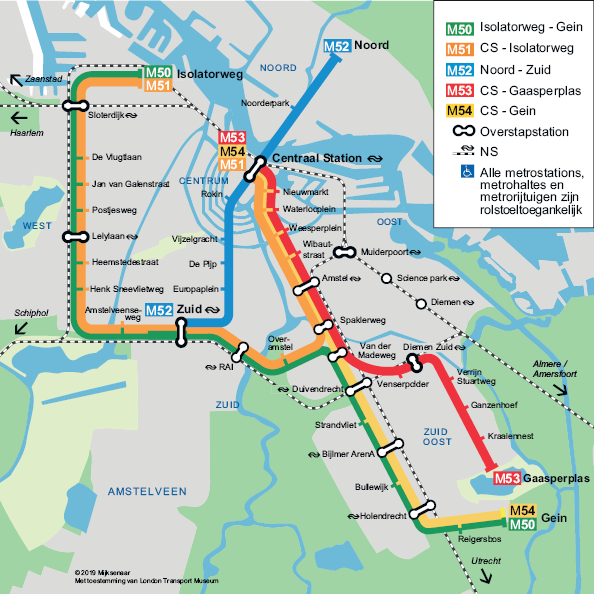
Use the metro map as a reminder that every model answers some questions while omitting others. section 2.3
Figure 4.10 Sensemaking exercise example using three options in a triangle. Using a pyramid offers several advantages: it captures nuanced opinions by providing a middle ground, reduces polarization by avoiding binary opposition, increases the accuracy of sensemaking collection by reflecting a wider range of perspectives, and enhances engagement by better matching individual views.
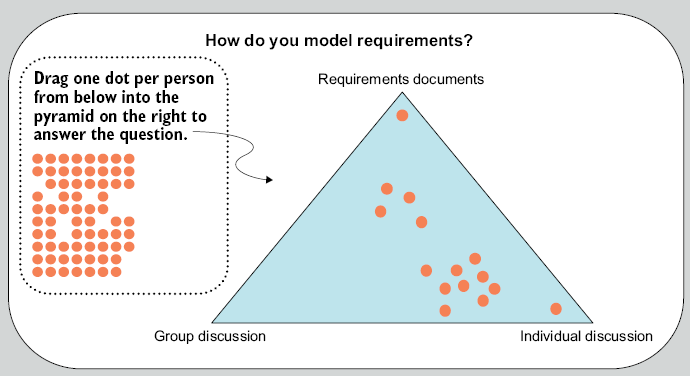
Use the pyramid-style exercise to collect nuanced opinions, reduce polarization, and represent a wider range of perspectives. section 4.3.4
Figure 4.11 Sensemaking exercise example using a four-quadrant diagram
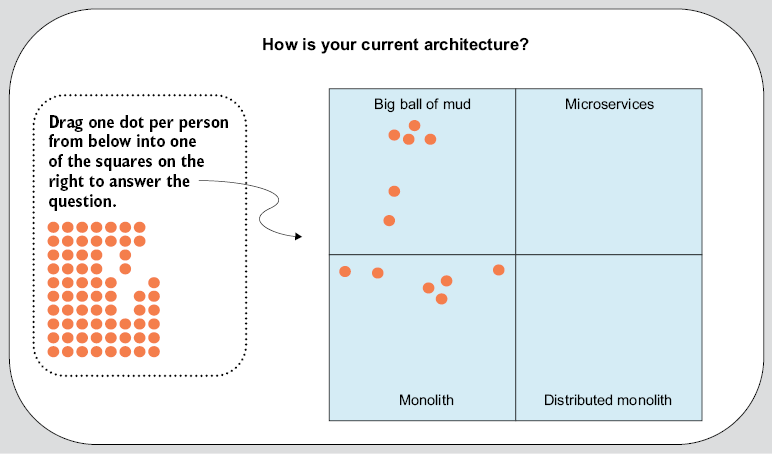
Use the four-quadrant diagram as an alternative structure for collecting and comparing group perspectives. section 4.3.4

