Phase kickback transfers a phase from a controlled unitary’s target to the control’s relative phase. Prepare the control in superposition and the target in an eigenstate: if U|ψ⟩ = e^(2πiθ)|ψ⟩, controlled-U maps |+⟩|ψ⟩ to (|0⟩ + e^(2πiθ)|1⟩)|ψ⟩/√2. The target is unchanged and unentangled; the control now carries θ. section 5.3.1 section 5.3.2
The effect is observable only after choosing a measurement that converts relative phase into differing outcome probabilities. For eigenvalues +1 and −1, the control remains |+⟩ or becomes |−⟩; a Hadamard and computational-basis measurement distinguish them. A generic superposition need not become orthogonal after a sign change, requiring repeated experiments. section 5.1.1 section 5.3.2
Figure 5.5 To use the phase kickback trick for phase estimation, we need a control qubit in a superposition state (the \(\ket{+}\) state is commonly used) and a target register of qubits in the state that is an eigenvector of the unitary we’re exploring. When we apply the controlled variant of this unitary, the target register remains unchanged, but the control qubit acquires a relative phase on the basis state \(\ket{1}\). This relative phase can be analyzed to extract informa-tion about the eigenphase that corresponds to the eigenvector.
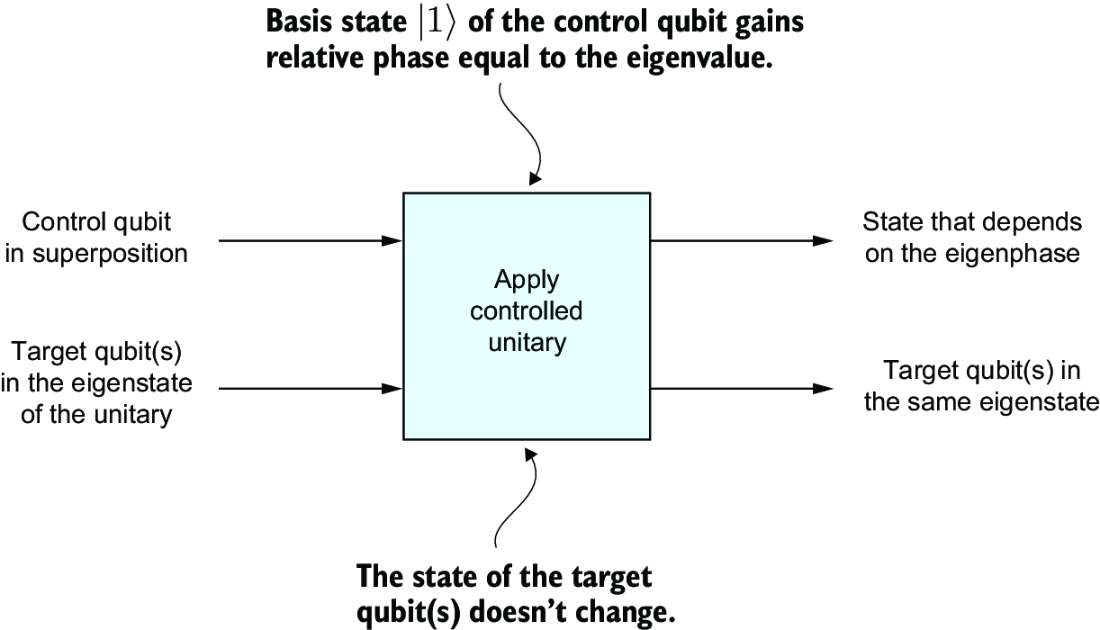
Inspect the essential circuit pattern: a |+⟩ control, an eigenstate target register, and controlled-U leave the target intact while encoding its eigenphase on the control. section 5.3.1
Phase kickback supplies a reusable bridge from controlled computation to phase-based algorithms:
- Phase estimation encodes an eigenphase on one or more control qubits. Iterative methods estimate probabilities over repeated runs; adaptive methods recover binary digits with successively adjusted circuits; quantum phase estimation applies inverse quantum Fourier transform before measurement. section 5.3.2 section 5.3.3 section 5.3.5
- A marking oracle can become a phase oracle by applying it to an auxiliary |−⟩ qubit. Marked inputs acquire a −1 relative phase while the auxiliary qubit remains unchanged. section 7.1.1 section 7.1.3
Turning a marking oracle into a phase oracle
For marked bit strings 001 and 110, prepare an input superposition and an auxiliary |−⟩ state, then apply the marking oracle. The input amplitudes for 001 and 110 change sign, while the auxiliary qubit can be uncomputed. Qiskit retains the auxiliary qubit as part of the circuit; Q# allocates, resets, and releases it. section 7.1.2 section 7.1.3
