Iterative phase estimation estimates the eigenphase θ of a unitary U when an eigenvector |ψ⟩ is available. It uses one fixed circuit repeatedly: prepare a control qubit and |ψ⟩, apply controlled-U, measure, collect outcome statistics, and infer θ from the resulting probabilities. It therefore trades a very small circuit for many runs. section 5.3.2 section 5.5
Phase kickback supplies the signal. With the control in |+⟩ and U|ψ⟩ = e^(2πiθ)|ψ⟩, controlled-U produces (|0⟩ + e^(2πiθ)|1⟩)/√2 on the control while leaving the target separable. A direct computational-basis measurement is uninformative—both outcomes remain equally likely—so the circuit must use a measurement arrangement whose probabilities depend on the relative phase. section 5.3.2
The repeated-run workflow is:
- Prepare the known eigenvector of U and an additional control qubit in a specified state. section 5.3.2
- Apply controlled-U to encode the eigenphase as a relative phase of the control qubit. section 5.3.2
- Measure the control using the circuit’s chosen measurement procedure and repeat enough times to estimate outcome probabilities. section 5.3.2
- Calculate the eigenphase from the experimentally estimated probabilities. section 5.3.2
Terminology matters. Here, iterative means rerunning the same circuit and estimating a phase-dependent probability distribution. Adaptive phase estimation instead learns binary digits one at a time and changes later circuits using earlier results. Adaptive methods can require fewer runs, but their circuits are more complicated. section 5.3 section 5.3.3 section 5.5
Arbitrary eigenphase on one control qubit
For an eigenphase θ between 0 and 1, phase kickback changes |+⟩|ψ⟩ into ((|0⟩ + e^(2πiθ)|1⟩)/√2)|ψ⟩. The target can then be ignored because it is not entangled with the control. Repeated measurements after an appropriate phase-sensitive transformation reveal probabilities from which θ can be estimated. section 5.3.2
Figure 5.6 In iterative phase estimation, we come up with a fixed quantum circuit that produces measurement outcomes with probabilities that are a function of the eigenphase. The circuit starts with the qubits in a specific state, applies a controlled variant of the unitary to get the information about the eigenphase into the phase of the control qubit and then performs a specific measurement. We run this circuit multiple times, gather enough statistics about the measurement outcomes to estimate the probabilities of measurement outcomes, and calculate the eigenphase from them.
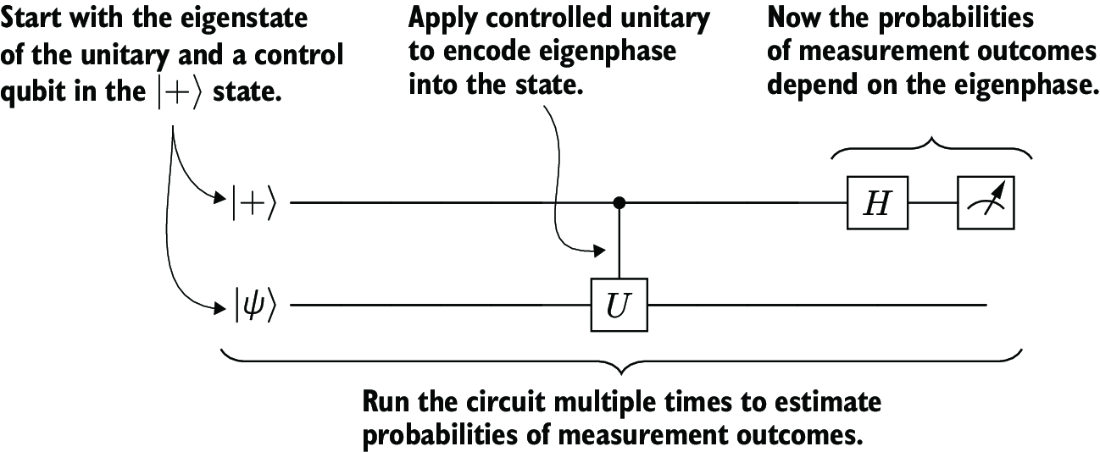
The circuit diagram makes the central distinction visible: one fixed controlled-unitary circuit is sampled repeatedly, and classical statistics are converted into an eigenphase estimate. section 5.3.2
