The S† gate is the inverse of S, with matrix [[1, 0], [0, -i]]. It multiplies the relative phase of |1⟩ by −i while leaving |0⟩ unchanged. section 5.3.3
Use S† as a classically controlled phase correction:
- In adaptive phase estimation, apply controlled U, then apply S† to the control qubit only when the previously measured phase bit θ₂ equals 1. section 5.3.3
- The correction removes the factor i contributed by θ₂ = 1, leaving the control state ready for a Hadamard gate and measurement of θ₁. section 5.3.3
Correcting a known phase contribution
When θ₂ = 1, the control state contains a relative phase factor e^(πi/2) = i. Applying S† contributes −i and cancels this factor; when θ₂ = 0, no correction is needed. section 5.3.3
Figure 5.7 In adaptive phase estimation, we learn the phase one binary digit at a time. We start by running a circuit that allows us to learn the least significant binary digit. After this, we use a different circuit, parts of which depend on the information we’ve discovered so far, to learn the second least significant binary digit. If there are more digits to learn, the process is repeated, with different circuits for each digit.
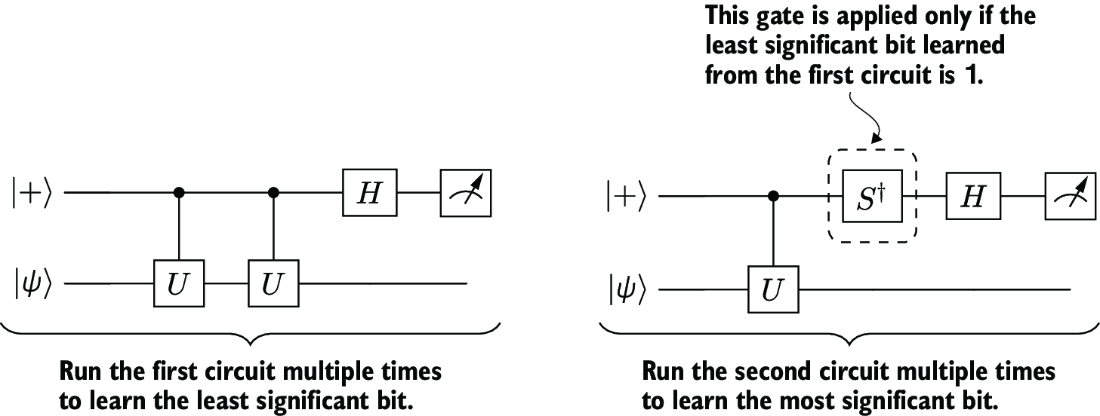
Trace how adaptive phase estimation changes its circuit after each measured binary phase digit. section 5.3.3
