Pheromone evaporation reduces simulated pheromone concentration over time, weakening older search information in ant colony optimization (ACO). It is one phase of pheromone updating; pheromone deposit is the other. section 10.2 section 10.6
The evaporation rate controls the balance between following established paths and exploring alternatives:
- With a rate of 0, trails persist indefinitely, encouraging repeated selection of one path and risking entrapment in a local optimum. section 10.2
- With a rate of 1, trails disappear at the maximum rate, forcing random exploration and potentially slowing convergence. section 10.2
- Intermediate settings let better paths attract ants while allowing older information to fade and other paths to remain discoverable. section 10.2 section 10.6
Ant foraging
Several ants begin at a nest with equal pheromone values on two paths, so each path initially has equal selection probability. After traversal, evaporation weakens existing trails before new pheromone is deposited. Repeating this process can strengthen promising paths without permanently fixing the colony to its earliest choice. section 10.2
Figure 10.4 Effect of evaporation rate during the food foraging process. In the simulation, the ants initiate their search for food from the central nest, which is surrounded by three food sources shown as blobs. The pheromone trails are shown in white. Upon discovering a food item, an ant transports it back to the nest, leaving behind a chemical trail. This trail is then followed by other ants that pick up the scent, directing them toward the food source. As more ants continue to retrieve food, they strengthen the chemical trail.
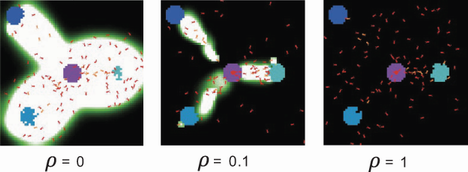
Use the foraging simulation to observe how different evaporation rates change trail persistence, path following, and exploration. section 10.2

