Photogrammetry creates a 3D model from overlapping 2D photographs. It is useful when a digital twin needs a visual record of an existing object or site, rather than clean geometry drawn from a CAD design. The resulting model can show wear, rust, weathering, and vegetation alongside the asset’s shape. section 7.4.2
A common approach is structure from motion (SfM). It estimates a scene’s 3D structure by analyzing how objects appear to change position across photographs taken from different viewpoints. SfM does not require specialized camera equipment. High-quality digital cameras and consumer drones make image capture accessible, while reconstruction software and available computing power make processing practical. section 7.4.2
Figure 7.12 The structure-from-motion problem. What kind of camera took these pictures, and where was it when each picture was taken? Image © Piero Toffanin, OpenDroneMap, reproduced with permission.
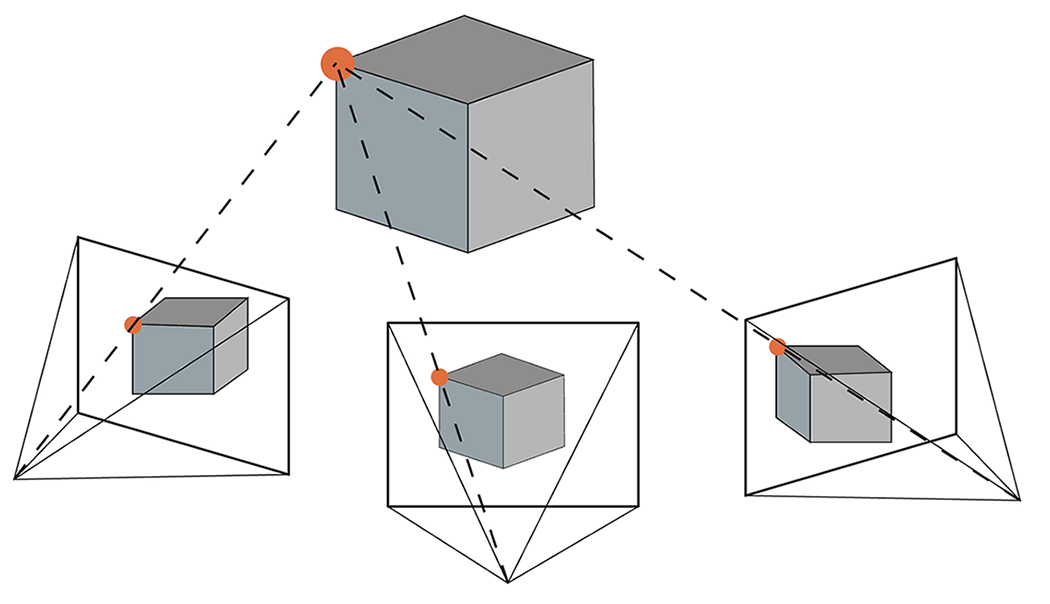
Use the three camera viewpoints to see the central reconstruction problem: relating multiple pictures of the same object to a three-dimensional representation. section 7.4.2
Choose photogrammetry according to the job the model must do:
- For an older facility with missing or outdated blueprints, create an as-built record of current conditions without manually modeling the site. section 7.4.2
- For a hazardous or inaccessible structure, combine drone photography with reconstruction so operators can inspect the model from a desktop. Large models can support measurements within 1–3 cm, but that figure is not a universal accuracy guarantee. section 7.4.2
- For teaching, reconstruct physical specimens as 3D representations. Anatomical models have reduced students’ reliance on scarce specimens and costly labs, as well as exposure to chemicals used with physical specimens. section 1.4.4
Photogrammetry favors accessible capture and photorealistic texture, but reconstruction is processing-intensive. When millimeter-level geometric accuracy is the priority, LiDAR point clouds are the stronger choice, at the cost of more expensive capture equipment and higher hardware demands. Select the representation against the inspection or visualization requirement, not visual realism alone. section 7.6
