A wireless LAN controller (WLC) port is a physical connector, typically an RJ45 or USB connection, used to cable the controller to another device or management network. It differs from a WLC interface, which is a logical entity comparable to a switch SVI. section 21.2.1
WLC physical ports serve four roles:
- Console port: provides standard local console access. section 21.2.1
- Service port: provides dedicated out-of-band management; it does not support VLAN tagging and must connect to a switch access port. section 21.2.1 section 21.4
- Redundancy port: connects two WLCs to form a redundant pair. section 21.2.1
- Distribution system (DS) ports: connect to the network distribution system and can participate in a link aggregation group (LAG). section 21.2.1 section 21.4
DS-port LAG
A WLC connected to SW1 through DS ports 1 and 2 can use those links as a LAG. When aggregation is enabled, all DS ports belong to the LAG, but one functioning physical port is sufficient for operation. section 21.2.1 section 21.4
Figure 21.9 WLC ports and interfaces. Ports are physical connectors that connect to other devices, and interfaces are logical entities in the WLC.
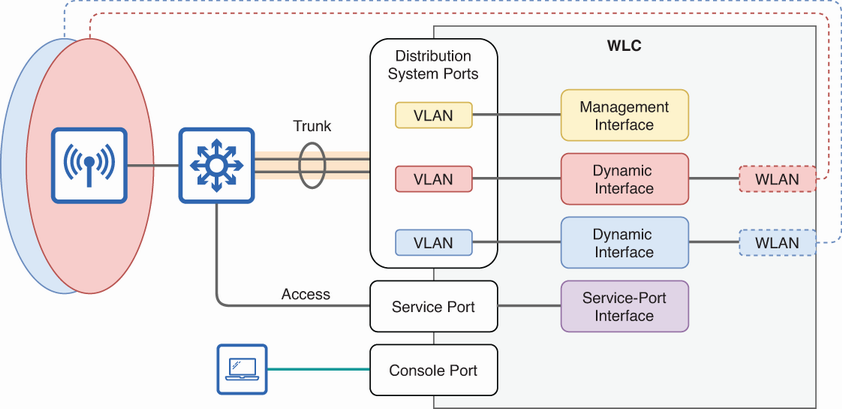
Use the figure to distinguish physical WLC connectors from logical WLC interfaces. section 21.2.1
