Physical separation places application parts on different machines or processes that communicate over a network. Think of separate buildings: a web server, an application server, and a database server. This describes deployment, not how code is organized. section 4.2.3
Figure 4.2 Layers are a logical separation, while tiers are a physical separation.
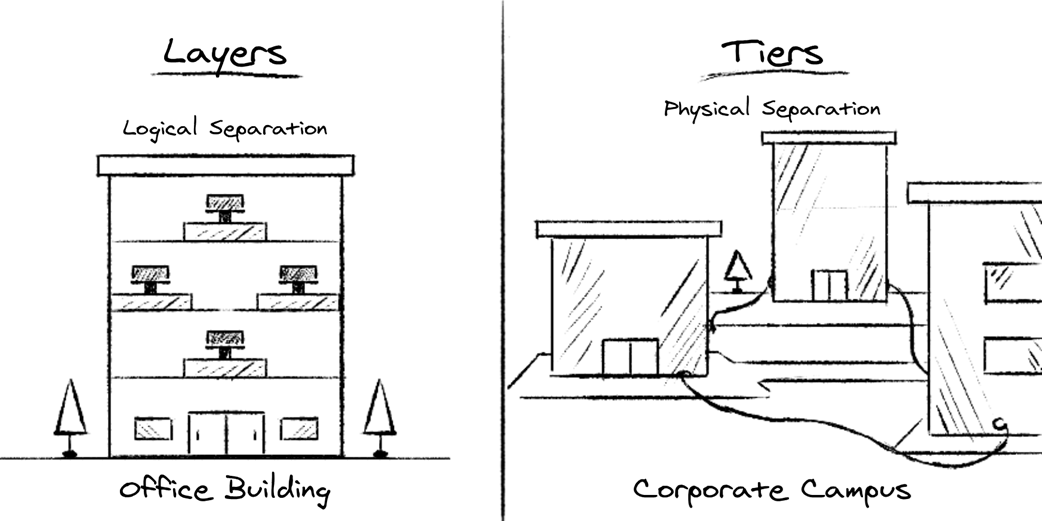
See how logical layers differ from physical tiers. section 4.2.3
Keep these distinctions clear:
- Layers organize code by responsibility; tiers describe where parts are deployed. section 4.2.3
- A three-layer application can run on one server or across three tiers. section 4.2.3
- Running the presentation layer on ten servers for traffic is horizontal scaling, not ten tiers. A new tier crosses a network boundary to a different responsibility. section 4.2.3
When separation is only physical
Five services that share one database remain tightly coupled: a schema change can break them all. If one service also depends on a live synchronous call to another, the caller can fail when the other service crashes. The result is a distributed monolith: network complexity without the agility of genuine decoupling. section 12.2.4
