liveBook · Manning

Tier

As explained in Grokking Software Architecture

A tier is a physically deployable part of an application separated from other parts by a process or network boundary.

A tier marks a physical deployment boundary. Unlike logical layers that organize code by responsibility, tiers run on separate machines or processes and communicate over a network. section 4.2.3

One application, different deployments

A three-layer application can run on one server, or span web, application, and database servers. Running the presentation layer on ten servers is horizontal scaling, not ten tiers. section 4.2.3

Figure 4.2 Layers are a logical separation, while tiers are a physical separation.
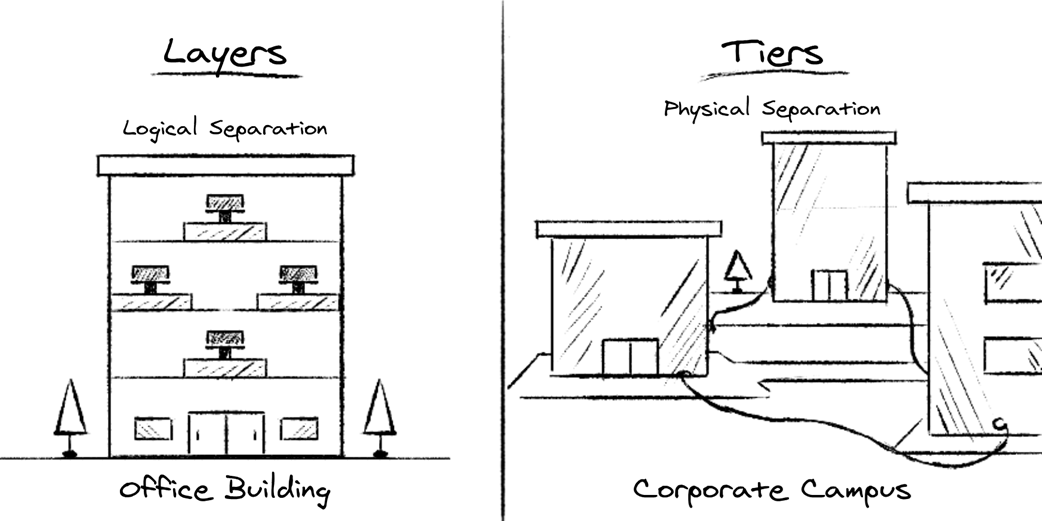
Compare the diagram’s logical code separation with its physical deployment separation. section 4.2.3

How Grokking Software Architecture covers it

How deep it goes
Defines tiers as deployment boundaries, contrasts them with code layers, and clarifies that horizontal scaling alone adds no tier.
Examples
Contrasts one server hosting three layers with separate web, application, and database servers, plus ten scaled presentation servers.
What you can do after
Evaluate whether a deployment change creates a tier by checking for a network boundary between responsibilities.
How it connects
Connects deployment tiers to layered architecture, N-tier applications, and horizontal scaling.

Related concepts

This explainer was generated by Manning's knowledge graph from the text of Grokking Software Architecture. The section links point to the parts of the book it draws on.