A physical system is the real-world object, process, or set of interacting components that a digital twin represents. The physical system is not the software model: it has an actual state and behavior, while the model describes selected parts of that state, the relationships among components, and how behavior may change. section 1.1 section 9.1
Decide what to represent by starting with a measurable objective. That decision determines which components, properties, and changes matter, how accurately to capture them, and which information sources are useful. A richer model is not automatically a better one: its fidelity should match the decisions it must support. section 2.0 section 2.7
A practical mapping starts with three questions:
- What must be known about current conditions or performance? Identify the relevant state and component relationships. section 1.1
- What existing evidence can establish structure or past conditions? Consider drawings, historical documents, photographs, and video. section 2.7
- What representation is sufficient? Depending on the decision, use structural metadata, a visual mesh, a precise design model, or captured geometry. section 2.7
Representing a facility
For a facility or infrastructure system, a building information model can organize structural and operational metadata. Photographs record conditions at particular times; point clouds can capture complex geometry and track physical changes. The objective determines which of these views is worth maintaining. section 2.7
To simulate the system, describe how inputs and internal state produce outputs, then run that model under chosen conditions. A digital twin keeps the representation connected to observations from the physical system; information, decisions, or actions may also flow back. If updates do not reflect current conditions, decisions based on the representation lose that grounding. section 9.1 section 1.1
Figure 1.1 The three main elements of a digital twin are the physical system, the virtual system, and the flow of data and information between them.
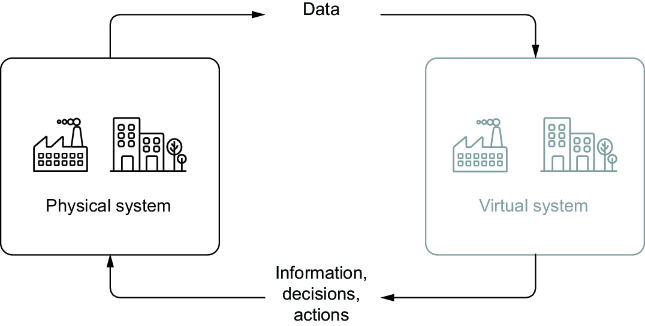
The diagram separates the physical system from its virtual representation and shows the data and information flowing between them. section 1.1
