A digital twin is a fit-for-purpose representation of a physical system, updated with real-world data to reflect its conditions and support decisions. It maintains state and can represent relationships among components. Simulation, prediction, optimization, and instructions sent back to the physical system are possible extensions, not requirements. section 1.0 section 1.1
A twin need not be a detailed 3D replica: a statistical model, relationship graph, or set of equations can serve the purpose. A virtual prototype without a physical counterpart is not yet synchronized with a real system. Some definitions reserve “digital twin” for bidirectional systems and call a one-way connection a digital shadow; broader usage includes both. section 1.0 section 1.1 section 1.2
From wind farm prototype to operational twin
Before installation, engineers simulate turbine designs under anticipated conditions. Once turbines are deployed, sensors stream operational data for models to detect bearing wear. The twin can then simulate maintenance scenarios and adjust blade pitch using weather data. The design simulation becomes an operational twin when it is linked to the physical turbines. section 1.2
A practical architecture starts with the decision the twin should improve:
- Define an objective and a measurable outcome; start with a small pilot and assess readiness to scale. section 1.6 section 1.6.1
- Collect and transport data from sources such as documents, sensors, cameras, and external APIs. section 1.6
- Process and store the data in visual, mathematical, or relational models, then analyze or simulate the system. section 1.6
- Where justified, close the loop by sending actions to the physical system, with permissions and oversight appropriate to the risk. section 1.6 section 1.2.5
Figure 1.13 High-level architecture of a digital twin, showing how data about the real world is collected, stored, and processed to make decisions and affect outcomes
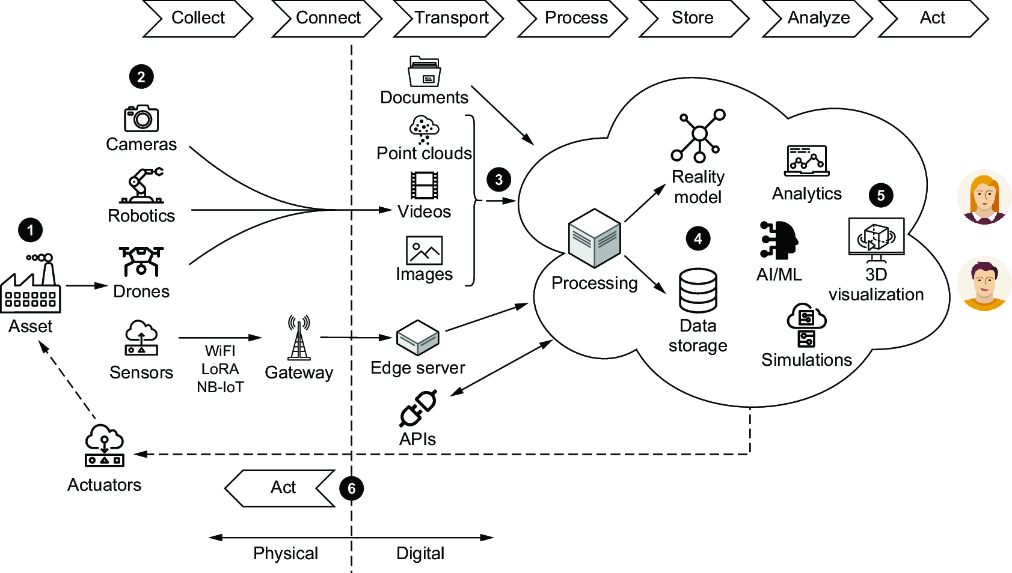
The architecture diagram connects collection and processing of physical-world data to decisions and possible actions. section 1.6
Capability can range from describing a system and regularly updating its state to prediction or autonomous operation. These are not mandatory stages: a twin may have strong simulation or prediction while retaining human approval for actions. The right level depends on the objective, not on maximizing autonomy. section 1.3 section 1.3.2
Data quality and operational ownership determine whether the twin remains useful. Connectivity gaps, inaccessible data, sensor drift, stale readings, measurement uncertainty, and missing context can undermine the model. Assign ownership, validate and version models, protect data, and restrict who can modify models or trigger physical actions. section 1.6.2 section 1.6.5
A twin may not be worth its cost when a simple dashboard or alert solves the problem, the required data cannot be obtained, or the organization cannot maintain and act on it. Validate the need for a synchronized representation before committing to the additional infrastructure and maintenance. section 1.5.8
