A graph drawing is easier to follow when edges do not cross. A flow chart, for example, can be clear in one layout and confusing in another even though its vertices and edges are unchanged. A planar embedding is a crossing-free way to draw a graph in the plane. section 15.1
Represent each vertex by a distinct point in the plane and each edge by a non-self-intersecting curve between its endpoints. For the drawing to be a planar embedding, an edge must not pass through another vertex or intersect another edge, except at a shared endpoint. An abstract graph is planar if at least one such drawing exists. A drawing with crossings therefore does not, by itself, prove that the graph is non-planar. section 15.1.1 section 15.2.1
Try moving a vertex
A naïve drawing of the complete graph K4 appears to have crossing edges. Move one vertex past the crossing, and the same graph has a planar embedding. By contrast, neither K5 nor the complete bipartite graph K3,3 has one. section 15.2.1 section 15.1.1
Figure 15.8 Two embeddings for K4. Although it would seem like a good candidate for non-planarity, it’s enough to move one vertex around to find a planar embedding, as shown on the right.
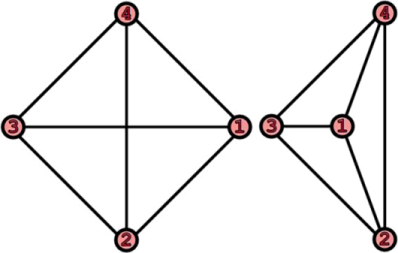
Compare the two drawings of K4: changing the layout removes the apparent crossing without changing the graph. section 15.2.1
To decide whether a crossing-free layout is possible, use a planarity test rather than judging one drawing. Kuratowski’s theorem characterizes the obstruction through K5, K3,3, and subdivisions of those graphs. Algorithms can test planarity and return a planar embedding in linear time, though their implementations are complicated; a simpler approach may be more practical for small graphs. section 15.1.1 section 15.2.5
A planar embedding is a starting point for visualization, not a guarantee of a readable diagram. Keep adjacent vertices reasonably close, avoid winding edges, and preserve a useful sense of flow. When the graph is non-planar, crossings cannot all be eliminated; minimizing them is a different problem, and finding the minimum crossing number for a general graph is NP-complete. section 15.3 section 15.3.1
