A plane is a flat two-dimensional geometric surface extending indefinitely in two independent directions. In three dimensions, an equation such as 0.3x + 0.2y - z + 3 = 0 describes one by assigning z to every combination of x and y. section 2.3.1
Planes provide a practical geometric language for describing intersections. Two nonparallel planes intersect in a straight line; parallel or coinciding planes do not produce a single intersection line. section 2.3.1
Common representations connect planes with broader geometric constructions:
- An implicit equation describes which points belong to the plane without constructing them one at a time. section 2.3.1
- A three-dimensional line can be represented as the intersection of two planes. section 2.3.1
- A surface can be created by transforming the x-y plane, much like bending an infinite sheet of metal. section 8.2.1
- A parametric surface uses two parameters, commonly written as f(u, v) → (x, y, z). section 8.2.1
A plane equation
The equation z = 0.3x + 0.2y + 3 describes a plane. Rewriting it as 0.3x + 0.2y - z + 3 = 0 makes its implicit form explicit and supports geometric reasoning about intersections. section 2.3.1
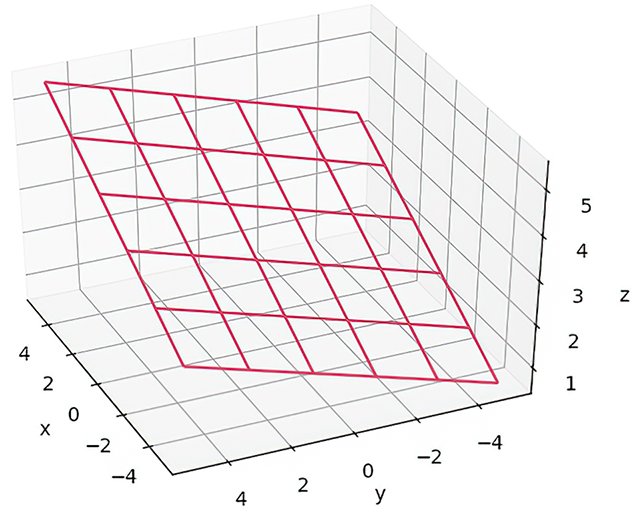
View the illustrated plane equation and its equivalent explicit and implicit forms. section 2.3.1
