A planning component is an optional agent subsystem that constructs a trajectory—a sequence of actions—for a complex task. Instead of reasoning through one tool call at a time, an agent can plan subtasks first, then execute them. This can reduce sequential delays and support parallel work, while dependencies between subtasks still limit what can run simultaneously. section 8.12
Planning addresses several weaknesses of a simple action loop:
- It can prevent an agent from becoming stuck in repeated reasoning or action cycles, although execution still needs an action limit. section 8.12
- It can divide a larger task into independent subtasks and send those subtasks to multiple tools simultaneously. section 8.12
- It works best when tasks contain parallelizable work; steps that depend on earlier tool results must remain sequential. section 8.12
Complex software work
For a task such as code generation evaluated through SWE-bench, an agent may first plan its trajectory, separate independent activities, execute them concurrently where possible, and then review the result through reflection. section 8.12
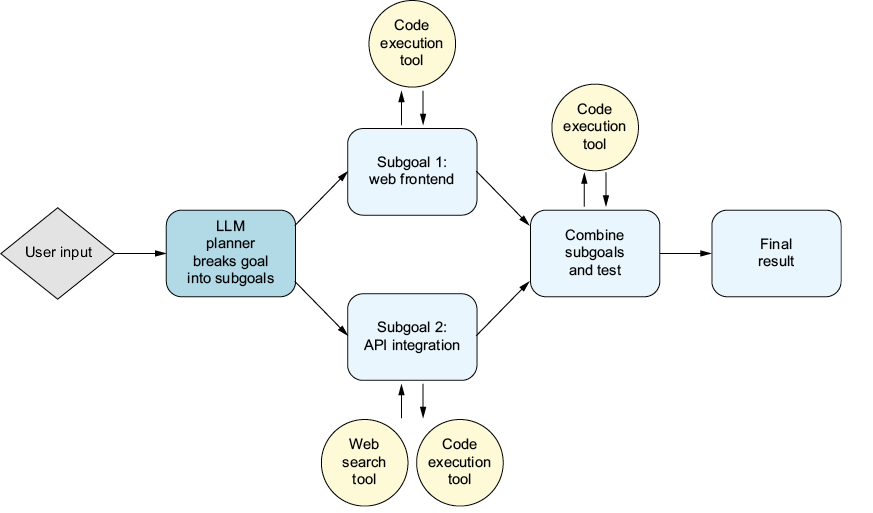
A flow diagram can clarify how planning precedes execution and enables parallel actions. section 8.12
