Platform as a service (PaaS) provides a managed application platform so developers can deploy software without managing the operating system, patches, updates, and several maintenance tasks. That removes much of the infrastructure busywork—less “yak shaving,” more application building—while leaving customers responsible for their applications and data. section 1.1
Figure 1.2 Cloud computing abstraction layers. The responsibility shifts between you and the cloud provider across IaaS, PaaS, and SaaS. As you move up the layers, the provider manages more—from physical infrastructure and virtualization in IaaS, to the OS and runtime in PaaS, and nearly everything in SaaS—leaving you to focus on just your applications and data.
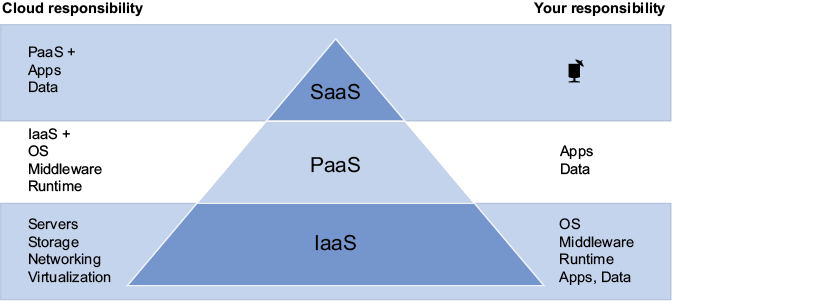
Use the abstraction-layer diagram to compare responsibilities across IaaS, PaaS, and SaaS: PaaS places the provider in charge of the OS and runtime while customers focus on applications and data. section 1.1
PaaS changes the operational trade-off rather than eliminating responsibility:
- Azure always maintains the platform OS, including security updates, platform dependencies, and OS maintenance. section 6.2.3
- Networking is mostly managed by Azure, although hybrid solutions may require customers to manage access to virtual networks. section 6.2.3
- Azure manages much of an application's platform security, while customers still configure options such as public internet access. section 6.2.3
- Identity remains shared: customers configure identity providers, user identities, monitoring, and logging, while Azure supplies services such as Entra ID. section 6.2.3
- Compared with serverless, PaaS offers more control and scaling choices but requires more configuration; applications may also take longer to start. section 8.5



