A platform service is a cluster capability deployed through standard cluster configuration rather than exposed as a uniquely provisionable resource type for developers. This distinction separates platform-wide capabilities from extensions. section 8.2
Platform services provide the safer first boundary for distributing ownership as adoption grows. Teams can move service responsibilities beyond the core platform product organization before considering extensions, which should wait until the platform is beyond its MVP and has meaningful adoption. section 8.2
Operational implications include:
- Use separate release orchestration pipelines as services and extensions scale, while deploy-event automation remains local to the cluster. section 8.2
- Treat the service-versus-extension boundary as an organizational scaling aid, not merely as a way to configure technology for higher load. section 8.2
Figure 8.2 The easiest way to understand the difference is to focus on extensions. When deployed, an extension enables developers to provision a resource through the Kubernetes API that Kubernetes does not natively support.
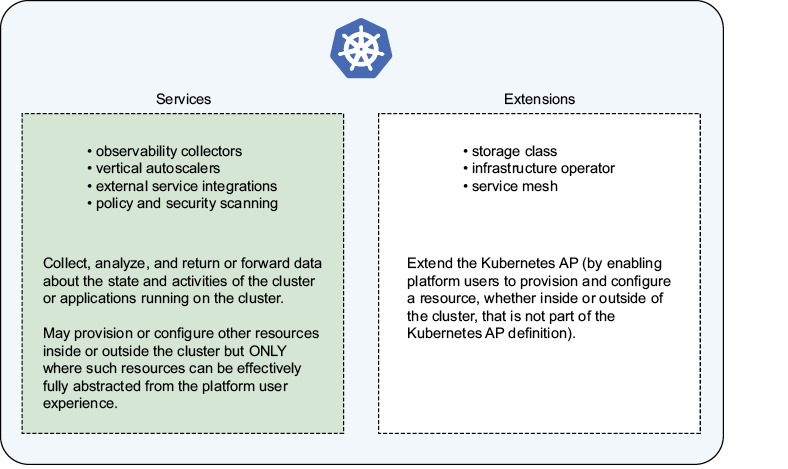
Compare a platform service with an extension: an extension enables developers to provision a non-native resource through the Kubernetes API. section 8.2
