A point is a geometric location: a building block from which curves and surfaces are made. On a coordinate plane, it can be written as a tuple of real-number coordinates, such as A = (0.5, 1.5). The tuple records where the point is; it does not turn the point into a number or give it vector arithmetic. section 2.1.3 section 2.8
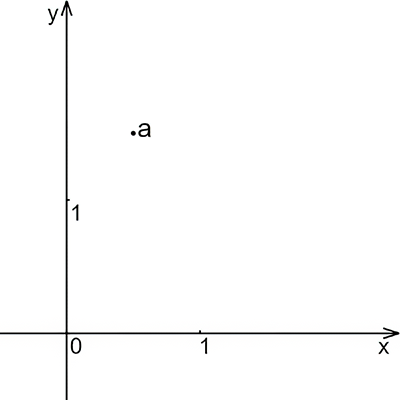
Read the ordered pair as the point’s position in Cartesian coordinates: 0.5 in one coordinate direction and 1.5 in the other. section 2.1.1
Points and vectors often look alike in code because both may appear as coordinate tuples. Their jobs differ. A point is part of a geometric object; a vector has direction and length and can show where a point lies relative to a chosen origin. Treating the notation as interchangeable can obscure that distinction. section 2.1 section 2.1.2
Keep these practical distinctions clear:
- Do not apply vector algebra directly to points. Vectors can be added and scaled; points have no algebra of their own. section 2.1.2 section 2.8
- A point vector is a vector conventionally drawn from (0, 0) to a point. It represents the point’s location, but the vector itself has only direction and length. section 2.1.2
- Choose coordinate and numeric representations deliberately in programs: programming values are models rather than true real numbers, and each model has trade-offs. section 2.1.3 section 2.8
Points, vertices, and triangle membership
For a triangle, its three vertices define it, but they are not its only points. Interior locations and locations along its edges are also triangle points. A vertex is always a point, while a point need not be a vertex. Also distinguish a point on a triangle from a point in its interior: an edge point is on the triangle but not in its interior. section 2.2.1
Figure 2.8 On a triangle and in a triangle have different meanings. Here, point D is on the triangle but not in it.
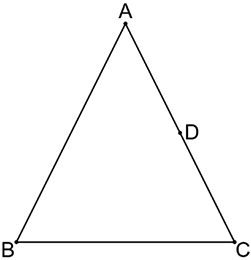
The edge case matters in geometry code and documentation: a location on an edge belongs to the triangle but is not in its interior. section 2.2.1
Precise point vocabulary prevents small ambiguities from spreading through geometric algorithms. Name vertices when you mean the defining corners of a triangle, and say whether a test accepts points on a boundary or only points in an interior. section 2.2.1



