A fixed output vocabulary works poorly when a task’s answers must come from its input. A Pointer Network (Ptr-Net) adapts attention to select input positions: its scores form a distribution over those positions, allowing it to copy or reorder input elements instead of generating new symbols. section 5.4
Figure 5.7 A seq2seq model (left). The input sequence (A) creates a vector used to generate the output sequence (B). The output dimensionality is fixed by the problem’s dimensionality and remains the same during training and inference [51]. Ptr-Net (right) is also an encoder-decoder. The encoder and decoder hidden states are denoted as (h1,…,hn) and (s1,…, sn), respectively. Ptr-Net encodes the input sequence into a code (A) that is fed to the generating network (B). At each step, the decoder produces a vector that modulates a content-based attention mechanism over the inputs. The attention mechanism outputs a softmax distribution with a dictionary size equal to the input length. Used with permission granted by the lead author (Oriol Vinyals).
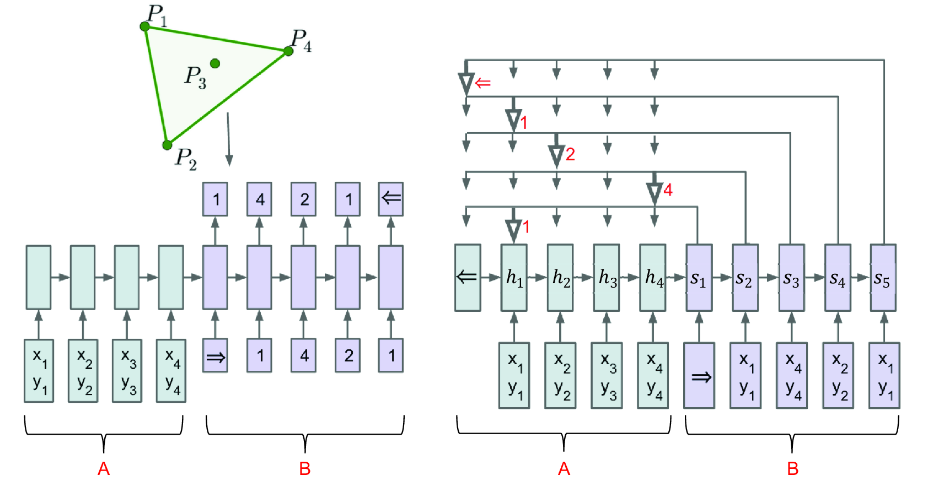
The encoder-decoder diagram shows the decoder applying attention to the inputs at each step; the output distribution’s size matches the input length. section 5.4
The architectural shift is small but consequential: attention becomes a way to point, not merely to build a context vector. This makes the model suitable for combinatorial tasks whose outputs are positions or items drawn from a variable-length input. section 5.4 section 5.4.2
Convex hulls and generalization
Given 50 two-dimensional points, a model must identify those forming the convex hull. Ptr-Net reached 72.6% accuracy, compared with 38.9% for LSTM with attention. When trained on lengths 5–50 and tested on 500 points, exact-order accuracy fell to 1.3%, while the area score remained 99.2%. section 5.4.1
Other tasks include Delaunay triangulation, traveling-salesperson tours, sorting, and scheduling. The pointer approach also foreshadowed copy mechanisms that select rare or out-of-vocabulary tokens from source text. section 5.4 section 5.4.1 section 5.4.2

