A polarized question frames two opposing but interdependent positions so a group can notice and discuss the polarity affecting its work. Use it during check-ins or sensemaking after clarifying the session outcome and agenda. section 10.3.2 section 10.5
Use the technique to:
- Validate with the group whether the tension is a polarity rather than a problem that can simply be solved. section 10.5
- Ask whether visualizing the polarity would add value before spending time exploring it. section 10.5
- Connect the competing needs in a proposal when the polarity is obstructing the session’s goal. section 10.5
- Invite listening and different perspectives rather than letting disagreement harden into reactive positions. section 10.5
Deep versus Wide
During BigScreen’s value chain mapping for the “Anytime, Anywhere” campaign, some participants wanted to explore users’ core needs more deeply while others wanted to keep the map broad and identify team-owned streamlets. Framing Deep versus Wide as a polarity helped make the tension discussable while preserving the group’s choice about where to focus. section 10.3.2
Figure 10.11 Conversation on four feet starts with Step 1, in which one participant gives out a statement. Then, the group moves to Step 2, where either they agree and stand with the person giving the statement, or they disagree. At that point, the facilitator turns to someone disagreeing to give another statement. Eventually, you can see the group polarize.
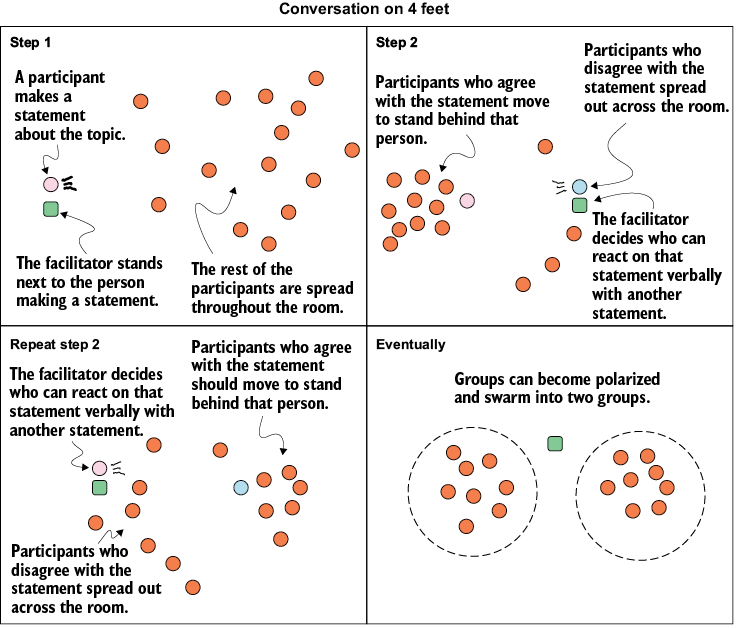
Trace how a facilitator elicits a statement, gathers agreement or disagreement, and makes polarization visible through movement and contrasting perspectives. section 10.5
