A pole is one of two seemingly opposing positions within an ongoing polarity. The poles are interdependent: each has benefits and drawbacks, and managing the tension requires moving between them rather than choosing only one. section 10.1.2
Map a pole by examining its effects at the extreme:
- Name the two poles and place them on opposite sides of a polarity map. section 10.2.1
- Record the upside and downside of each pole, using L+ and L− for the left pole and R+ and R− for the right. section 10.2.1
- Think in extremes: ask what happens if the group relies only on one pole. section 10.2.1
- Compare both perspectives together so the group can seek the positive effects of both poles. section 10.2.1
Deep versus Wide
In the Deep versus Wide polarity, Deep means modeling in detail and Wide means modeling something end to end. Deep can answer questions and reduce assumptions, while Wide provides an overall view; relying exclusively on either creates corresponding disadvantages. section 10.2.1
Figure 10.2 The four quadrants of a polarity map, representing the positive and negative effects of each pole. An alternative way to talk about positive and negative effects of a pole are the upside and downside of that pole.
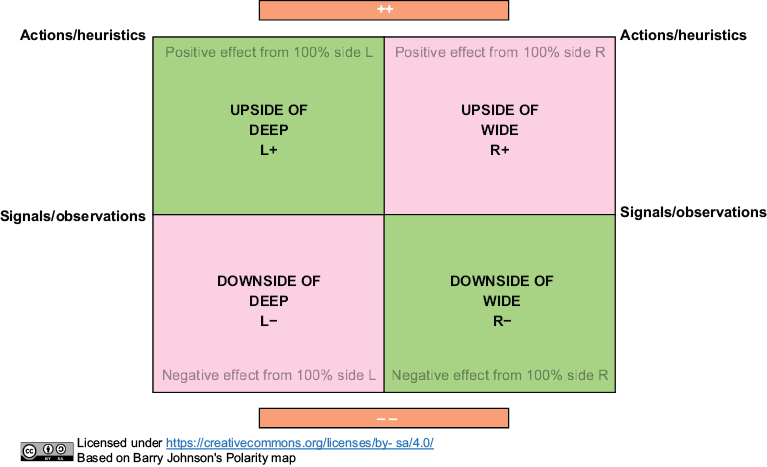
Use the four-quadrant polarity map to make each pole’s upside and downside visible at the same time. section 10.2.1
