Policing limits traffic to a configured rate or traffic contract. Traffic within the limit conforms; traffic above it exceeds and is normally dropped rather than buffered. section 10.5
Policing behaves differently from shaping in several operationally important ways:
- Drops exceeding traffic, while shaping buffers it in a separate queue and transmits it later at the configured rate. section 10.5
- Can re-mark exceeding packets instead of dropping them, allowing classification into a different queue. section 10.5
- Can apply per class or per interface, and can allow temporary bursts above the configured rate. section 10.5
ISP rate contract
An ISP can police customer traffic at 300 Mbps. The customer can shape outbound traffic to 300 Mbps so packets conform before reaching the ISP’s policer and avoid drops. section 10.5
Figure 10.21 Policing and shaping. Policing drops traffic that exceeds the configured rate limit, and shaping buffers it to smooth out the traffic rate.
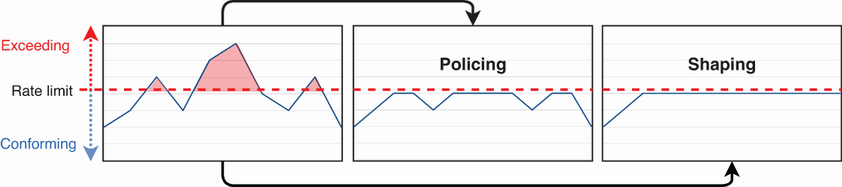
Compare policing’s dropping or re-marking of excess traffic with shaping’s buffering and smoothing behavior. section 10.5
Figure 10.22 A common use case for policing and shaping. The customer shapes outbound traffic to 300 Mbps to ensure that packets don’t get dropped by the ISP, which polices traffic to 300 Mbps.
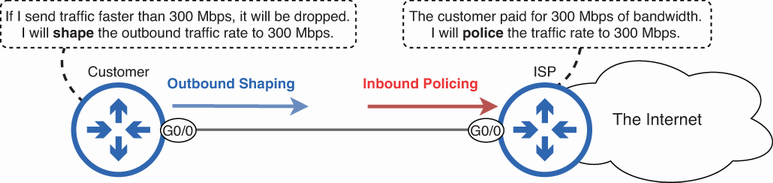
Trace the customer-to-ISP scenario in which outbound shaping prevents the ISP’s inbound policer from dropping excess packets. section 10.5
