Low Latency Queuing (LLQ) combines Class-Based Weighted Fair Queuing (CBWFQ) with a strict priority queue. Assign delay-sensitive traffic to the priority queue; when it contains packets, the scheduler services it first. When it is empty, remaining queues use CBWFQ scheduling. section 10.4.3
Key LLQ behavior and limitations:
- Treats the priority queue’s configured bandwidth as a maximum limit, not a minimum guarantee. section 10.4.3
- Protects lower-priority queues from starvation by limiting traffic entering the priority queue. section 10.4.3
- Drops or re-marks excess priority traffic when it exceeds the configured limit; this rate limiting is policing. section 10.4.3
- Differs from CBWFQ because CBWFQ guarantees each queue a minimum bandwidth but does not provide strict priority service. section 10.7
Priority bandwidth example
With 30 percent assigned to the priority queue, delay-sensitive EF-marked packets receive strict priority up to 30 percent of interface bandwidth. Excess EF traffic is dropped or re-marked into a lower queue. section 10.4.3
Figure 10.20 Low Latency Queuing (LLQ). Delay-sensitive packets are assigned to a priority queue that is always serviced first. The remaining queues are serviced using CBWFQ logic.
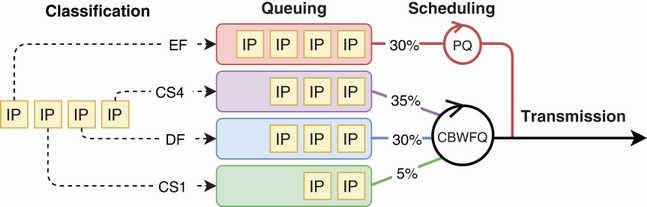
Visualizes strict priority service for delay-sensitive packets and CBWFQ scheduling for the remaining queues. section 10.4.3
