Priority Queuing (PQ) is a QoS scheduling technique for congested interfaces. It separates classified packets into up to four ranked queues and always services the highest-priority nonempty queue first. section 10.2.3 section 10.4.1
PQ operates one packet at a time:
- Classify arriving packets and place them into separate priority queues. section 10.4.1
- Scan queues from highest to lowest priority before each transmission. section 10.4.1
- Transmit from a lower-priority queue only when every higher-priority queue is empty. section 10.4.1
- Recognize queue starvation: sustained higher-priority traffic can cause lower-priority queues to be serviced very infrequently. section 10.4.1
Figure 10.18 Priority Queuing (PQ). Packets are classified based on markings (the example markings in the figure are arbitrary) and added to a queue. The scheduler only services a lower-priority queue if all higher-priority queues are empty.
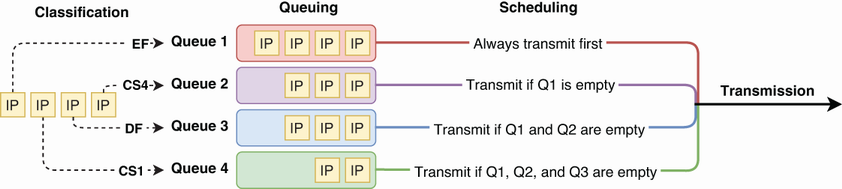
Visualizes classification by packet markings and the strict rule that lower-priority queues wait until all higher-priority queues are empty. section 10.4.1
