A policy lifecycle is the controlled management of an authorization policy from its initial need through creation, review, deployment, monitoring, change, and retirement. It prevents temporary overrides, duplicated rules, and obsolete requirements from silently persisting in production. Each stage records why a policy exists, who is responsible, how it was checked, and whether it should continue. section 14.0 section 14.2.6
Figure 14.2 The policy management life cycle. Policies go through distinct stages (creation, review and approval, deployment and use, monitoring, and eventually retirement) with updates feeding back into the review process. The life cycle ensures that authorization policies remain current, coherent, and aligned with organizational intent.
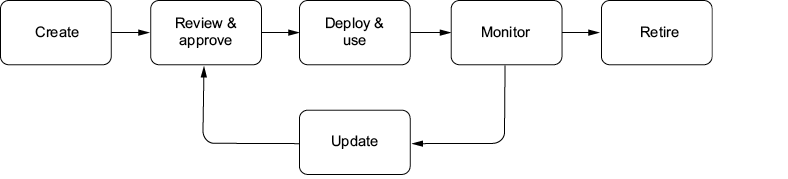
The lifecycle is a feedback loop rather than a one-way release path: monitoring and updates return policies to review before they are redeployed or retired. section 14.2
A practical lifecycle combines organizational oversight with technical controls:
- Create with a documented need and rationale. An architectural decision record (ADR) captures the context, alternatives, decision, consequences, and related artifacts. section 14.2
- Review and approve through named responsibilities. Owners, authors, reviewers, approvers, coordinators, and auditors make responsibility visible without requiring every decision to be centralized. section 14.9 section 14.3.2
- Validate before release. Compile, type-check, and test policies against a shared schema and representative data; CI/CD pipelines can lint, validate, and test changes before deployment. section 13.5.8 section 14.2
- Deploy with scope and rollout control. Store policies centrally, distribute the relevant bundle to each policy decision point (PDP), and stage changes when deployment timing differs across tenants. section 13.5.8
- Monitor behavior and feed evidence back into review. Decision logs, incidents, audit findings, and operational results reveal drift, regressions, or requirements for an update. section 14.3 section 14.3.1
- Retire deliberately. Review dependencies, deactivate in a coordinated way, and archive the retired policy with metadata that links it to any successor. section 14.2.6
Tracing a privacy-policy change
A policy requiring an approved purpose for access to personal data can be linked to an ADR and compliance metadata, tested before deployment, and observed through decision logs. If an access incident occurs, the incident ticket can point to the affected policy and ADR; the resulting finding becomes tracked feedback for a revised policy. The resulting evidence connects stated intent, policy logic, release checks, and runtime enforcement. section 14.5
Lifecycle management is broader than policy deployment. Deployment answers how a policy reaches enforcement; governance establishes who owns the lifecycle, which standards apply, and how engineering, operations, and oversight coordinate when a policy affects multiple systems. Shared templates, metadata, reviews, and records reduce policy drift while allowing teams to retain day-to-day ownership. section 14.3 section 14.3.1
The operational result is authorization that remains explainable and auditable over time. Stable policy identifiers and versions let decision logs identify the exact policy text involved in a decision, support rollback of problematic changes, and preserve evidence for forensic review or regulatory audit. section 13.5.8 section 14.5
