liveBook · Manning

Poor communication/breakdown

As explained in Collaborative Software Design: How to facilitate domain modeling decisions

Poor communication or breakdown is a resistance behavior involving the stopping or limiting of communication because a person feels unheard.

Poor communication or breakdown is resistance that appears when people feel unheard or believe their opinions are not being valued in group decisions. It may involve stopping or limiting participation, individually or collectively. Resistance is normal rather than childish; the practical task is to notice coherent patterns and explore whether they reflect the session or wider tensions. section 8.1.3

Watch for signals such as:

  • Staring out the window when a particular topic arises, or turning off a camera in a remote meeting. section 8.1.3
  • Sarcastic jokes that interrupt the conversation or cause the group to lose its thread; cultural context matters when interpreting them. section 8.1.3
  • Excuses for not following a decision, including claims that the work was about to be done. section 8.1.3
Figure 8.2 The resistance line. The further down the line the minority group goes, the less efficient the group will be able to function.
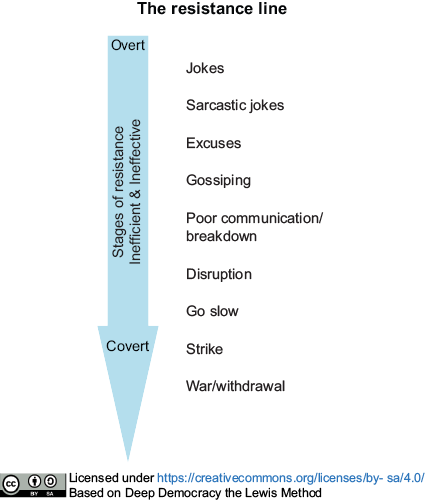
Use the resistance line to discuss how escalating resistance can reduce group efficiency and to identify patterns before they deepen. section 8.1.3

How Collaborative Software Design: How to facilitate domain modeling decisions covers it

How deep it goes
Defines the behavior, gives observable examples, and places it on a resistance line without prescribing a resolution.
Examples
Uses withdrawal, camera-off behavior, sarcasm, and excuses as observable resistance examples.
What you can do after
Diagnose resistance by observing recurring individual or group patterns and considering their immediate or broader context.
How it connects
Connects poor communication/breakdown with resistance, conflict resolution, facilitation, and group decision-making.

Related concepts

This explainer was generated by Manning's knowledge graph from the text of Collaborative Software Design: How to facilitate domain modeling decisions. The section links point to the parts of the book it draws on.