Population size is the number of candidate solutions maintained by a population-based optimization algorithm. In a genetic algorithm, it must balance search coverage against computational effort: larger populations promote diversity and exploration, while smaller populations converge faster. section 7.3.2 section 8.5
Choose or adapt population size according to the search:
- Avoid assuming that a very large population improves performance; chromosome length also influences the appropriate size. section 7.3.2
- Increase the population when progress stalls and greater diversity or exploration is needed. section 8.5
- Decrease it when the population becomes excessively diverse and faster convergence is preferable. section 8.5
Ticket pricing initialization
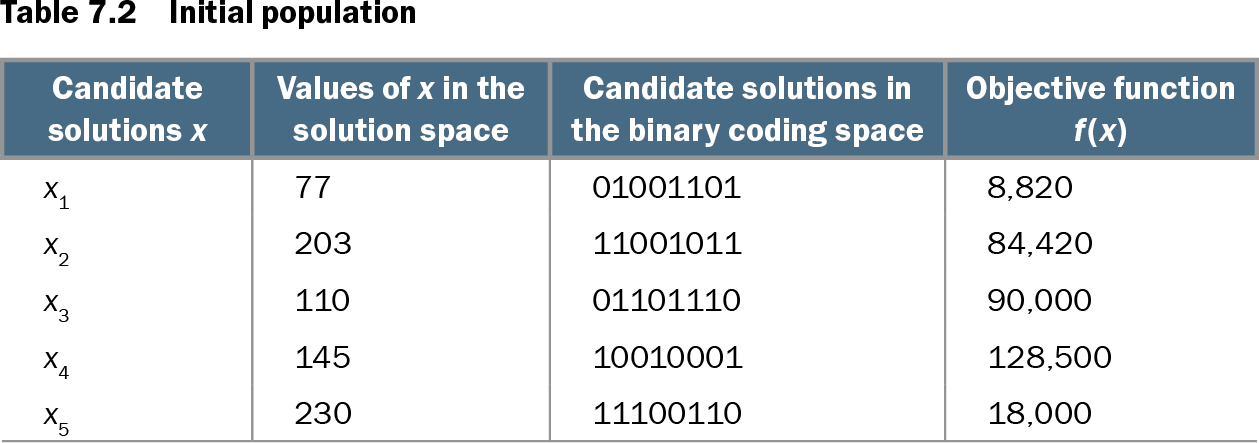
A genetic algorithm for ticket pricing can begin with a population of five randomly generated candidate solutions. Each candidate has a solution value, binary chromosome, and objective-function value; selection then chooses parents for crossover and mutation. section 7.3.2
Table 7.2 Initial population (view table figure)
| Candidate solutions x |
Values of x in the solution space |
Candidate solutions in the binary coding space |
Objective function f(x) |
|---|---|---|---|
| x1 |
77 |
01001101 |
8,820 |
| x2 |
203 |
11001011 |
84,420 |
| x3 |
110 |
01101110 |
90,000 |
| x4 |
145 |
10010001 |
128,500 |
| x5 |
230 |
11100110 |
18,000 |
Compare the five initial candidate solutions, their binary encodings, solution values, and objective-function scores. section 7.3.2