A pose is the spatial arrangement of an entity’s body parts. Modeling how that arrangement changes over time supports trajectory prediction and applications such as medical consultation, remote home security, filmmaking, and robotic planning. section 6.1
For human-pose prediction, treat the observed pose sequence as sensor-like input and learn relations among its components. The model then predicts future trajectories rather than only classifying a single configuration. section 6.1
An NRI-based pose-prediction workflow proceeds as follows:
- Encode input data into edge probabilities representing whether components are connected. section 6.4.3
- Decode future trajectories conditionally on those inferred relations, using a GRU. section 6.4.3
- Optimize reconstruction loss together with KL divergence, repeating training until convergence. section 6.4.3
- Evaluate predictions across multiple future horizons with mean squared error, recognizing that accuracy generally declines farther into the future. section 6.4.3
Long-horizon pose prediction
A trained NRI model predicts the next timestep with an MSE of 0.00008 and achieves 94% accuracy forty timesteps into the future, outperforming the reported LSTM and GAT results. section 6.4.3
Figure 6.14 Pipeline for the NRI model
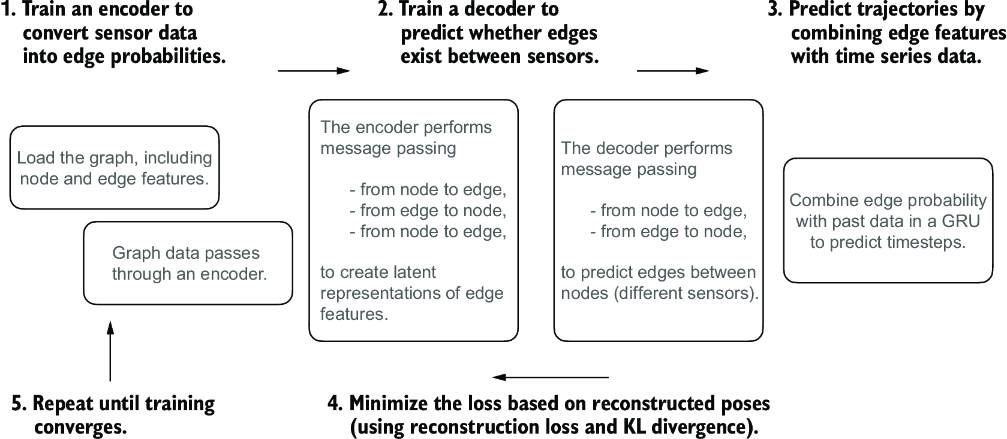
Use the NRI pipeline diagram to follow encoding, relational decoding, trajectory prediction, and pose-loss computation as one process. section 6.4.3
