PostgreSQL, commonly called Postgres, is an open-source relational database used to persist application data. In a Rust web application, it stores courses durably instead of losing them when the service restarts. section 4.2.1 section 4.0
A practical integration pairs Postgres with SQLx, which sends raw SQL, checks queries at compile time, provides a connection pool, and exposes asynchronous database connections. This fits an asynchronous Actix Web service because the service can continue other work while waiting for database responses. section 4.2.1 section 1.3.1
Set up and exercise a database-backed Rust service in these steps:
- Install Postgres, create the ezytutors database and a database user, then grant that user access. section 4.2.2
- Define a course table with serial identifiers, required tutor and name fields, a timestamp default, and seed records. section 4.2.2
- Configure DATABASE_URL, create a PgPool in Rust, run a parameterized query, and display the returned course rows. section 4.2.2
- Develop the integration iteratively: first test connectivity with vanilla Rust, then add the Actix service, tests, handlers, and persistence. section 4.0
Querying a seeded course
Create ezy_course_c4 with course_id, tutor_id, course_name, and posted_time columns; insert two courses; set DATABASE_URL; then run a Rust program that queries course_id = 1 through PgPool. The program prints the First course record with its timestamp. section 4.2.2
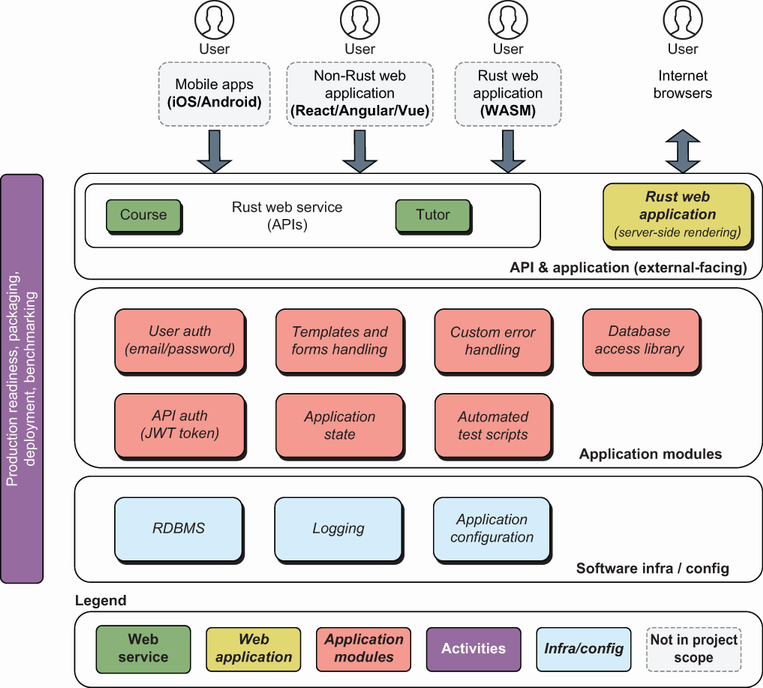
Use the application architecture diagram to locate Postgres alongside the Rust web service, server-rendered client, and persisted course data. section 1.3.1










