When an action produces an outcome, causal reasoning asks what would have happened under a different action. A potential outcome is the outcome of the same variable in that alternative world, whether observed or not. Comparing observed outcomes with unobserved potential outcomes turns counterfactual questions into causal effect questions. section 8.0 section 8.4.1
Use the framework to distinguish the worlds being compared:
- Treat the actual world as the possible world whose event outcomes were observed; treat other possible worlds as hypothetical. section 8.4.1
- Compare outcomes across parallel worlds that share common attributes but differ in the treatment, condition, or intervention under consideration. section 8.4.1
- Represent hypothetical conditions with counterfactual notation and use probability to quantify uncertainty about claims concerning those worlds. section 8.5
- When estimating effects from observed data, use ignorability only as an explicit assumption: treatment and counterfactual potential outcomes are conditionally independent given confounders. section 10.3.2
Changing the decision rule
Suppose a person chose a partner using a scorecard and asks whether the relationship would have worked if chemistry had guided the choice. The observed relationship is one outcome; the relationship under the alternative choice is a potential outcome. The same logic can identify which feature changes would have altered a classifier’s prediction, supporting explainable AI and algorithmic recourse. section 8.0 section 8.5
Figure 10.9 We have two parallel worlds: world A where E is not intervened upon, and world B where E is intervened upon.
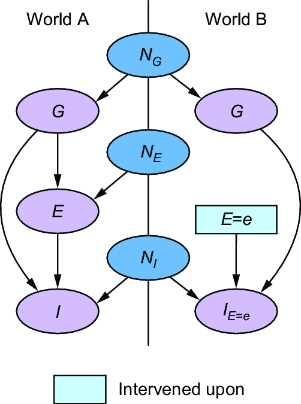
Compare an untreated world with a world where the exposure is intervened upon; the paired diagram makes the potential-outcome contrast explicit. section 10.3.2

