Power sourcing equipment (PSE) supplies electrical power over the same Ethernet UTP cable used for data. A PoE-enabled switch can therefore power IP phones, cameras, wireless access points, and access-control devices without separate power cables or nearby outlets. section 10.1.2
Protecting connected devices requires four stages:
- Detection applies low voltage to determine whether the device supports PoE. section 10.1.2
- Classification assesses the powered device’s needs and allocates power from the available supply. section 10.1.2
- Startup supplies the appropriate voltage; normal operation continues delivery while monitoring current. section 10.1.2
Verify power allocation
Run `show power inline` to view the available, used, and remaining power budget, plus each port’s operational state, device class, and maximum allocation. In the example, two class 3 devices receive 15.4 watts each. Apply `power inline police` to selected interfaces to enable power policing. section 10.1.2
Figure 10.3 SW1, the PSE, supplies electrical power to IP phones (PDs) using PoE.
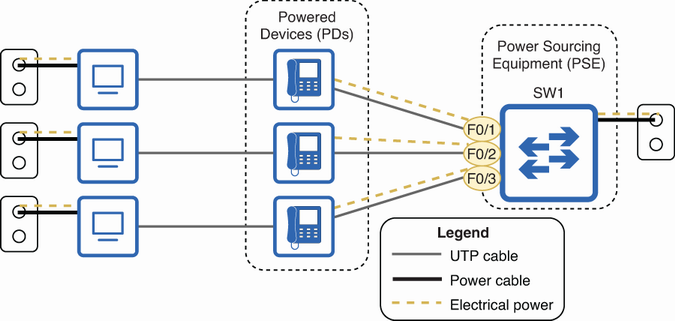
Trace the relationship between the switch acting as PSE and IP phones acting as powered devices. section 10.1.2
