PPD (Prearranged Payment and Deposit) is an ACH standard entry class commonly used for direct deposits and recurring payments. It supports transfers between accounts held at different banks, such as an employer paying an employee through payroll. section 2.2
A typical PPD payment begins when an employer or payroll processor creates a file containing the payment amount, account number, and receiving bank’s routing transit number. The originating bank sends files to an ACH operator, which sorts transactions by routing number and forwards them to receiving banks for posting. section 2.2
PPD is useful when designing ACH-file storage because it provides a focused starting scope:
- Store PPD entry-detail records separately from file, batch, and addenda records. section 5.1
- Preserve file ordering with sequence values and retain unparsable records for later handling. section 5.1
- Use foreign keys to connect parsed PPD records with their parent records and maintain referential integrity. section 5.1
Recurring payroll deposit
An employer using bank X pays an employee using bank Y. A payroll processor prepares the employee’s PPD information, bank X submits it through an ACH operator, and bank Y receives and posts the transaction. section 2.2
Figure 2.1 ACH processing flow
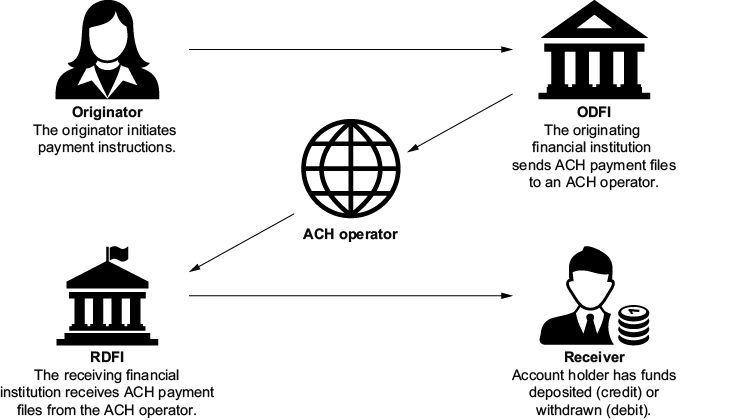
Use the ACH processing flow to trace how a PPD file moves from the originating bank through an ACH operator to receiving banks. section 2.2
