An International ACH Transaction (IAT) moves money electronically between accounts in different countries. It extends ACH beyond domestic payments, but adds precise formatting and regulatory obligations. Supporting IAT is therefore a product, data-model, parser, API, dashboard, and compliance change—not merely a new transaction label. section 11.0 section 11.10
IAT batches retain the 94-character ACH record limit, so international details are distributed across structured records. A batch is identified as IAT in its header; its entry records carry an addenda count and always have the addenda indicator set to 1. Each IAT entry has 7–12 addenda records; an initial implementation can handle the seven mandatory records, 710 through 716. section 11.2 section 11.2.1
The seven mandatory addenda records separate the international payment details into identifiable components:
- 710: foreign payment amount and receiver name. section 11.2.1
- 711–712: originator identity, street, and location details. section 11.2.1
- 713–714: originating and receiving financial-institution names, IDs, and branches. section 11.2.1
- 715–716: receiver identification, street, and location details. section 11.2.1
A small international gift payment
A sample IAT batch represents Elena Santiago in Bilbao, Spain, sending $1.00 from Iberia Global Bank to David Wiliams’s checking account at Futuristic FinTech. Its header uses the IAT description and GIFT entry description; FF3 signals fixed-to-fixed foreign exchange details, with USD as both originating and destination currency. section 11.2.1
Figure 11.2 Sample IAT batch
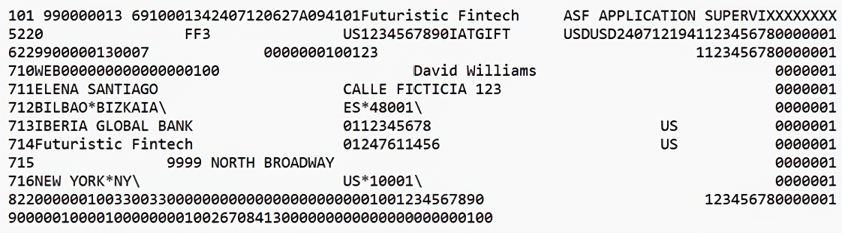
Inspect the sample batch as a fixed-width artifact before implementing field extraction, addenda ordering, or database persistence. section 11.2.1
A practical parser first detects IAT versus PPD from the batch header, then routes type-6 entry records and type-7 addenda to the matching routines. Track both expected record types and expected addenda types: reject out-of-order addenda, reset expectations after type 716, and verify that required records are present without duplicates. Build tests from independently verified expected values, then rerun PPD tests to guard against regressions. section 11.4 section 11.5.2
Persist IAT-specific headers, entries, and addenda in dedicated tables. For an API or dashboard, a compact batch query can combine PPD and IAT header fields, while a large entry query is clearer when split into PPD-specific and IAT-specific paths. The displayed fields and whether IAT shares existing components remain business and user-experience decisions. section 11.6 section 11.6.1 section 11.6.2
IAT processing also raises sanctions risk. Scan involved customers against OFAC’s Specially Designated Nationals list, use fuzzy matching to catch minor name variations, present actionable results, and retain scan outcomes for traceable compliance records. Large-file scanning may need file status and asynchronous processing. section 11.0 section 11.10 section 11.9.3
