A pre-shared key (PSK) is secret keying material configured on communicating devices before use. In WEP, the administrator shared the PSK as the Wi-Fi password; each packet concatenated it with a publicly transmitted three-byte initialization vector to form an RC4 key. section 4.3.2
WEP’s PSK arrangement fails because RC4 key scheduling exposes biases for carefully selected weak IVs. Repeated observations of known plaintext and ciphertext reveal keystream bytes, allowing the FMS attack to infer PSK bytes statistically. section 4.3.2
Recovering a WEP PSK
A packet generator creates IVs of the form [targetIndex, 255, random byte], concatenates each IV with the PSK, and encrypts a known SNAP header. After collecting 50,000 packets per byte, the exploit recovers "helloworld123"; with only 500 packets, several bytes are incorrect. section 4.3.2
Figure 4.13 WEP setup showing preshared keys and initialization vectors as input to RC4
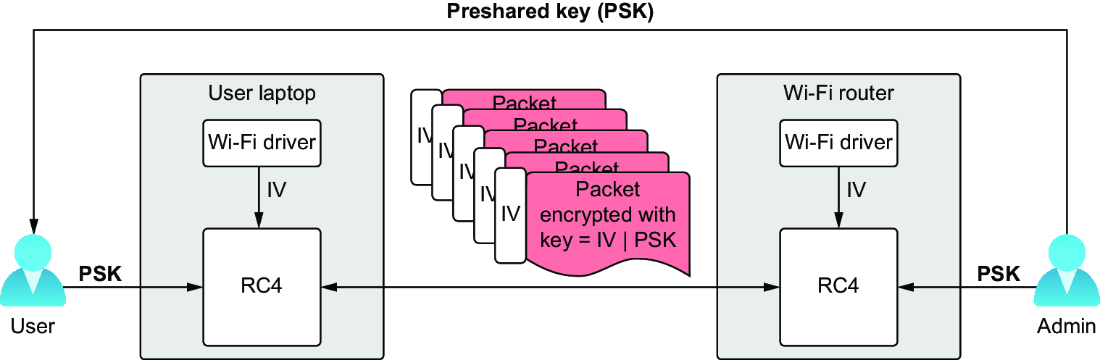
Use the WEP setup figure to follow how the PSK and public initialization vector become each packet’s RC4 key. section 4.3.2


