liveBook · Manning

Precalculation

As explained in Machine Learning System Design

Precomputation performs a calculation before its result is needed so that later processing can reuse the stored result.

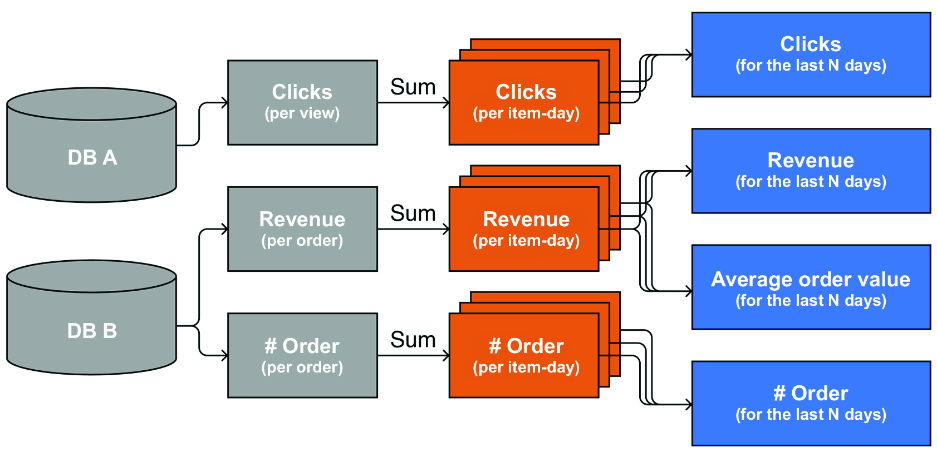
Precalculation moves feature computation ahead of dataset retrieval, so a feature store can reuse stored results instead of repeating expensive work. This matters when read latency is critical: batch features can be prepared after daily data processing, while the freshest events remain real-time inputs. section 11.4.2

A practical pattern is to:

  • Preaggregate raw clicks, prices, or revenue into item-day sums. section 11.4.2
  • Aggregate those intermediate results into reusable 7-, 14-, 30-, or 60-day windows. section 11.4.2
  • Combine precomputed features with real-time features during reads when recent events are essential. section 11.4.2
Figure 11.14 A hierarchy of aggregating used in a feature store
figure

Use the aggregation hierarchy to see how raw events become reusable intermediate and windowed feature results. section 11.4.2


How Machine Learning System Design covers it

How deep it goes
Defines precomputation, then explains staged aggregation, reuse, overlapping windows, and batch/real-time serving tradeoffs.
Examples
Uses clicks, prices, revenue, item-day sums, and 7-, 14-, 30-, and 60-day aggregation windows.
What you can do after
Apply it via a feature store to reuse staged aggregates and combine them with real-time features.
How it connects
Connects feature stores with feature engineering, batch processing, stream processing, and feature versioning.

Also explained in

Compare how 2 books explain precalculation →

Related concepts

This explainer was generated by Manning's knowledge graph from the text of Machine Learning System Design. The section links point to the parts of the book it draws on.