liveBook · Manning

Precedence graph

As explained in Optimization Algorithms: AI techniques for design, planning, and control problems

A precedence graph is a directed representation of task dependencies that specifies which tasks must be completed before others can begin.

A precedence graph is a directed representation of task dependencies: each relationship identifies work that must finish before dependent work can begin. It keeps task sequences feasible when assigning work to assembly-line stations. section 6.6

Bike assembly

A frame must be assembled before installing the forks and handlebar. Attaching the wheels depends on completing both the frame and forks. Thus, task 2 precedes tasks 3 and 4, as shown in a precedence diagram. section 6.6

Figure 6.21 A precedence diagram
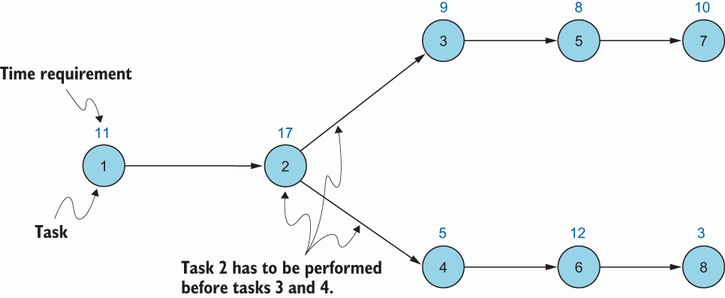
Inspect the precedence diagram to follow dependency edges between assembly tasks. section 6.6

How Optimization Algorithms: AI techniques for design, planning, and control problems covers it

How deep it goes
Explains dependencies through a bike example and diagram, then applies them within assembly-line balancing problems.
Examples
Uses bike assembly, precedence diagrams, task sequences, and workstation assignments as concrete examples.
What it assumes
Assumes familiarity with tasks and assembly stations while introducing dependency ordering through concrete examples.
What you can do after
Apply it to assign assembly tasks without violating dependency relationships.
How it connects
Connects task dependencies with assembly line balancing, workstations, cycle time, and tabu search.

Related concepts

This explainer was generated by Manning's knowledge graph from the text of Optimization Algorithms: AI techniques for design, planning, and control problems. The section links point to the parts of the book it draws on.