Query pushdown evaluates filters, projections, or aggregations as close as possible to the source. By reducing data scanned and transferred, it improves latency, resource use, and interactive query performance. section 8.2.1 section 9.2.1
In an Iceberg and Parquet lakehouse, pushdown works with metadata-driven pruning:
- Query engines use file-level and row-group statistics to skip data that cannot satisfy a filter. section 5.3.1 section 7.1.2
- A predicate such as WHERE id = 2 can be applied before unnecessary data is read into memory. section 5.3.1
- File sizing, metadata pruning, execution planning, parallelism, and caching often matter more than manually tuning row groups. section 5.3.1
Federated query execution
A federation engine can query data where it already lives, pushing filters, projections, and aggregations to databases, warehouses, lakes, or lakehouse catalogs instead of copying all data into a central store. section 8.2.1
Figure 5.8 Using metadata in Parquet row-group footers, we can tell which row groups to scan and which to skip for faster reads.
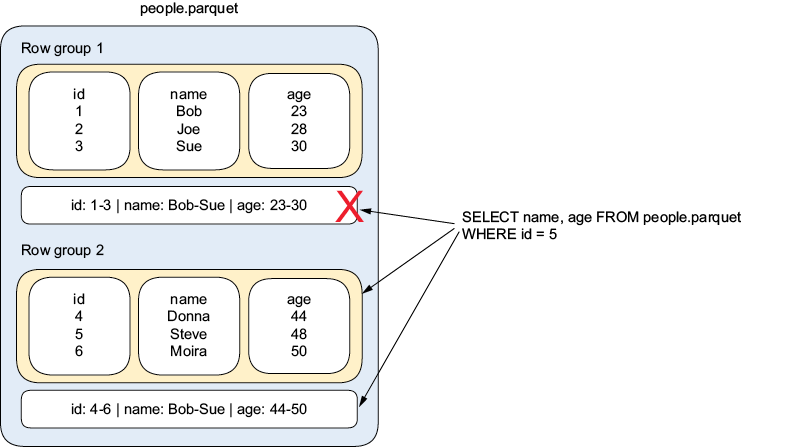
Use the row-group metadata diagram to see how column statistics identify row groups to scan and skip. section 5.3.1

