Predictive error measures the discrepancy between a model’s predicted outcome and the corresponding observed outcome. Lower error can indicate useful prediction, but it does not guarantee that a model supports sound intervention decisions. section 4.1.5
Pac-Man level design
Two models predict level time from synthetic data: one uses bonuses, while the other uses bonuses and ghosts. Their R-squared values are 0.9969 and 0.9996, suggesting similarly low predictive error. Yet when a designer jointly changes ghosts and bonuses, the models predict 11.52 and 17.03 minutes. Predictive accuracy on historical designs therefore does not establish which model answers a design intervention. section 4.1.5
Figure 4.4 Number of ghosts versus number of bonuses. There is a strong correlation between them because they have a variable in common: the designer’s creative process. Points have been slightly perturbed to avoid point overlap.
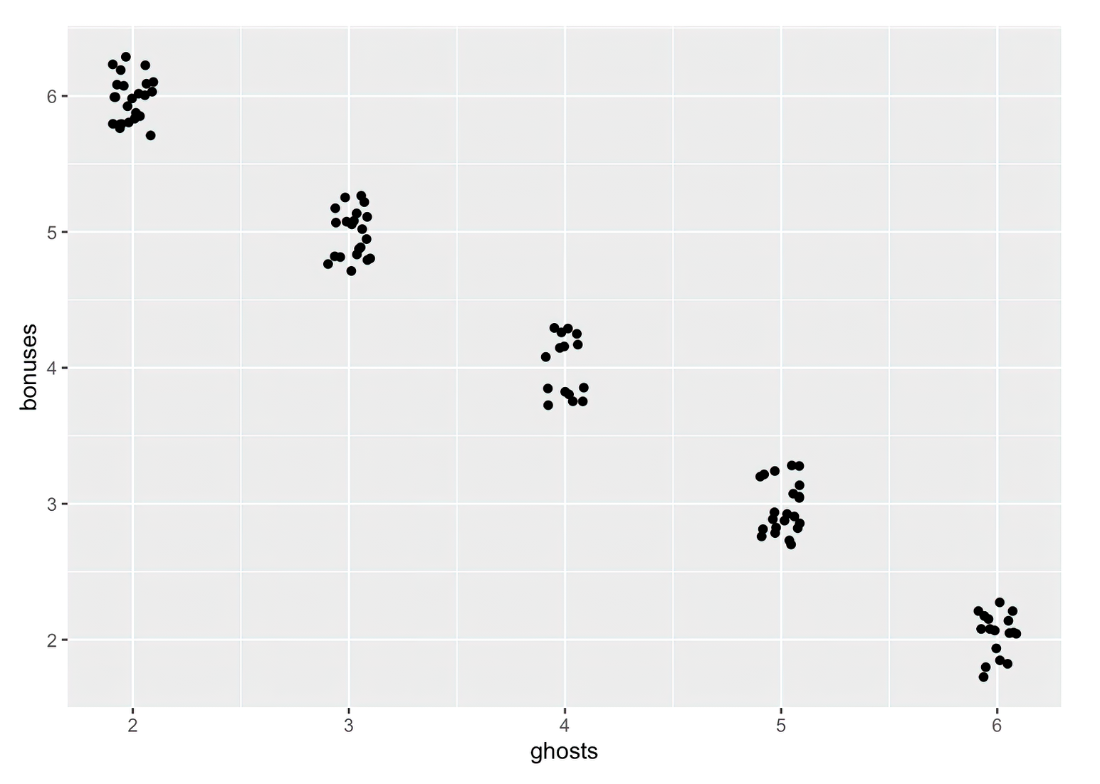
Use the correlation plot to inspect how the designer’s creative process links ghosts and bonuses, creating a misleadingly strong predictive relationship. section 4.1.5
