A preference list ranks possible matches from most to least preferred. In matching, one side can propose in list order while the other uses its own list to compare offers. section 2.4 section 2.1.2
The lists guide both sides of a match:
- Proposers approach potential matches in preference order. section 2.1.2
- Receivers use their ranking to choose between a new offer and a current match. section 2.1.2
A one-pass match
University X ranks Alice first and proposes to her. Alice’s list is [X, Y, Z], so she accepts the only offer; Y and Z likewise propose to their first choices, completing the match in one pass. section 2.1.1
Figure 2.3 Round 1 where students are proposers. Alice, Bob, and Carol propose to their first choices from the list. A conflict is seen between Bob and Carol, where both students opt for university X. X prefers Bob over Carol and rejects Carol.
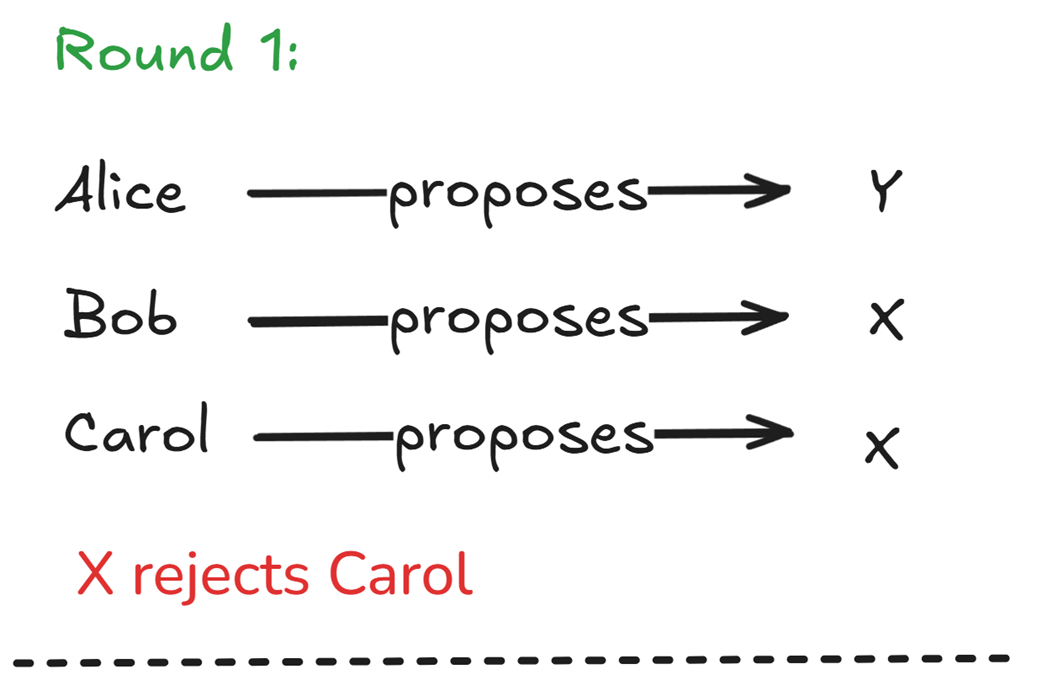
The figure shows how a ranked list helps resolve a conflict: X compares Bob and Carol, keeps its preferred candidate, and rejects the other. section 2.1.2
