A principal vector is an eigenvector from PCA that indicates a direction of variation in data. Its paired principal value measures the variance along that direction. The largest value-vector pair identifies maximum variance; subsequent vectors are orthogonal directions with progressively smaller variance. section 14.4
Geometrically, principal vectors form axes for projecting data onto a lower-dimensional manifold. A small principal value signals little variation, allowing that direction to be discarded with relatively low reconstruction loss and possible noise reduction. section 14.4
Correlated 3D data
For points clustered near the X0 = X2 plane, the two largest principal vectors lie within that plane. The smallest-value vector is normal to it, so setting that component to zero produces a 2D representation. section 14.4
Figure 14.3 The original 3D data in figure 14.3a shows high correlation: points are clustered around the X0 = X2 plane. The first principal component corresponds to the direction of maximum variance. The last (third) principal reduced to a 2D latent vector.
|
(a) Original 3D data |
|
(b) Lower-dimensional 2D representation obtained by setting the third principal value to zero |
|
(c) The principal vectors of the original data. The third principal vector is normal to X0 = X2 plane; the other two are in-plane. |
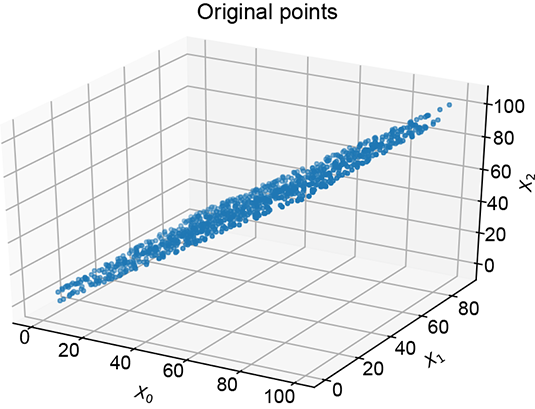
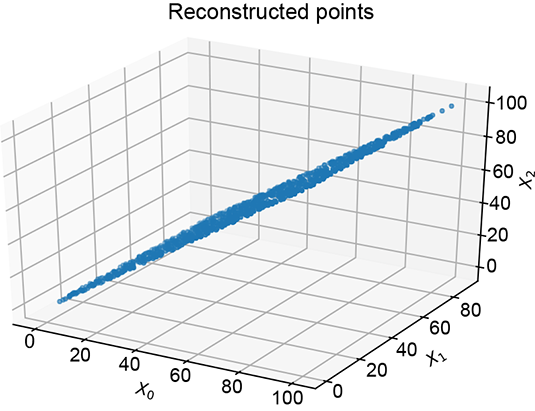
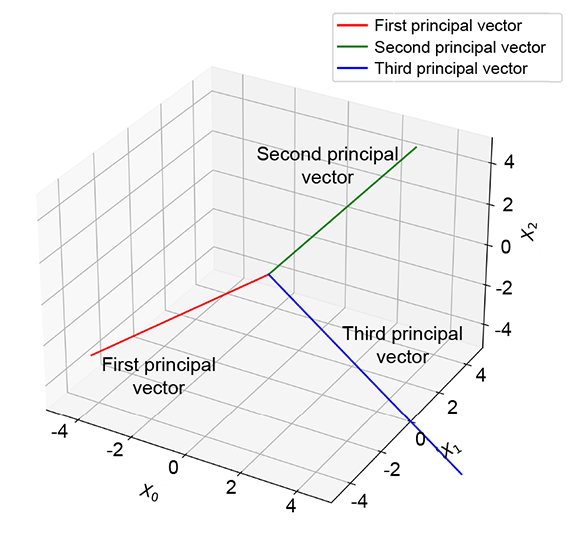
Compare the original 3D point cloud, its 2D projection, and the three principal-vector directions. section 14.4
