Priority Code Point (PCP), also called Class of Service (CoS), is a three-bit field in an IEEE 802.1Q Ethernet tag. It marks frames so later devices can classify them by the marking instead of repeatedly inspecting addresses, ports, or payloads. section 10.3.2
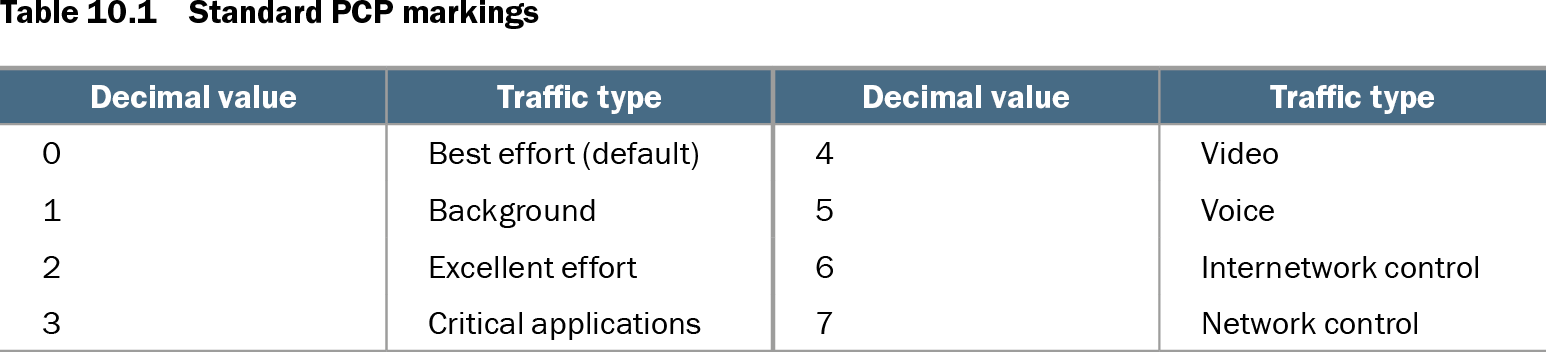
The three bits provide eight values. PCP 0 (000) is the default best-effort class, while PCP 5 (101) is the standard marking for voice traffic and should receive high priority. section 10.3.2
Figure 10.10 PCP is a three-bit field in the 802.1Q tag of the Ethernet header.
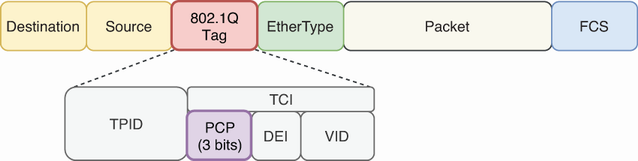
Locate PCP within the 802.1Q tag of the Ethernet header. section 10.3.2
Table 10.1 Standard PCP markings (view table figure)
| Decimal value |
Traffic type |
Decimal value |
Traffic type |
|---|---|---|---|
| 0 |
Best effort (default) |
4 |
Video |
| 1 |
Background |
5 |
Voice |
| 2 |
Excellent effort |
6 |
Internetwork control |
| 3 |
Critical applications |
7 |
Network control |
Review the standard decimal PCP values and their traffic classes, including best effort, video, voice, and network control. section 10.3.2
PCP’s major limitation is scope: the field exists only in 802.1Q-tagged frames, such as frames on trunk links or voice VLANs. Untagged traffic, including frames sent between routers, carries no PCP marking. section 10.3.2 section 10.7