Before handing over your data, ask: what will this organization collect, use, share, retain, and protect? A privacy policy is the organization’s statement of those practices—and a signal of how it views your privacy. section 5.8
Privacy policies turn broad principles such as transparency, control, respect, and trust into an organization’s public position on personal data. Their practical value depends on whether ordinary people can understand them and use them to decide whether to participate. section 5.8
Read a privacy policy as evidence about:
- What kinds of data an organization collects and how it uses or leverages them. section 5.8
- Which organizations may receive the data, including service providers, business partners, government agencies, researchers, or other third parties. section 5.9
- Whether the policy offers understandable explanations and meaningful control, rather than mainly protecting the organization from data-related rights claims. section 5.8
- How stable the promises are when ownership, management, business models, terms of service, or policies change. section 1.2.1
When a policy reveals the real reach of data sharing
A healthcare provider’s policy allowed protected health information to move among a long list of clinical workers, insurers, consultants, regulators, researchers, law enforcement personnel, and other organizations. In genetic genealogy, policies could also change after investment or management changes, leaving people with little lasting control over DNA data they had submitted. section 5.9 section 1.2.1
Figure 5.1 Privacy at University of Michigan29
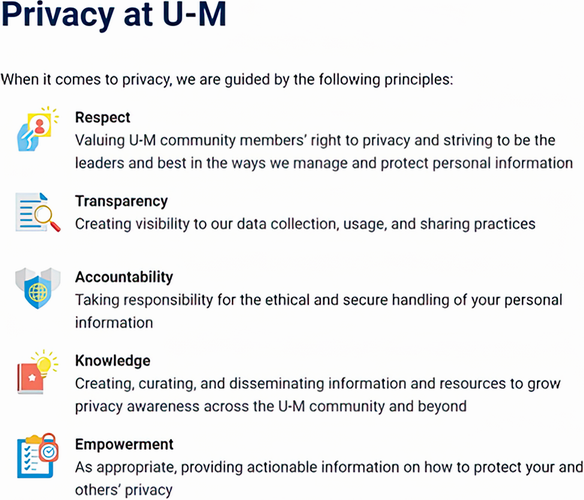
Use the University of Michigan privacy principles as a compact view of the values that can guide a privacy policy. section 5.8
A policy is not a guarantee that control will last. Once data is handed over, later access, ownership changes, and rewritten policies can alter the practical meaning of the original promise. Reading policies before signing up helps people make more informed choices about whom to trust with their data. section 1.2.1 section 5.8
