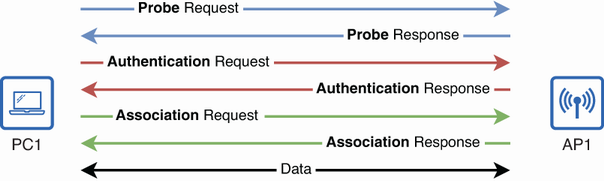
A probe request is an 802.11 management frame a wireless client sends to discover nearby access points and the SSIDs they advertise. The exchange supports the client association process: after discovery, the client authenticates and associates before sending or receiving wireless data. section 19.1.2 section 19.3
Clients discover access points in two ways:
- Active scanning sends probe requests and listens for probe responses; it discovers access points quickly but can reduce battery life. section 19.1.2
- Passive scanning listens for periodic beacon messages advertising each BSS; it conserves battery life but may discover networks more slowly. section 19.1.2
- Discovery is followed by an authentication request and, if successful, an association request. section 19.3
Figure 19.3 The client association process. The probe request/response exchange allows PC1 to discover AP1. PC1 then authenticates and associates with AP1.
Trace the probe request and response exchange that lets a client discover an access point before authentication and association. section 19.1.2
