Active scanning discovers nearby wireless access points before a client connects. The client sends probe requests, receives probe responses, and learns which SSIDs are available within range. section 19.1.2
The client association sequence is:
- Send a probe request to discover nearby access points and their offered SSIDs. section 19.1.2
- Listen for probe responses from access points. section 19.1.2
- Request authentication and then association with a discovered access point. section 19.3
- Send and receive wireless data only after successful authentication and association. section 19.1.2
Finding Wi-Fi at a new location
When a phone or laptop displays available SSIDs at a café or another home, it may have discovered unfamiliar access points by exchanging probe requests and responses. Constant active scanning can discover networks quickly but may shorten battery life. section 19.1.2
Figure 19.3 The client association process. The probe request/response exchange allows PC1 to discover AP1. PC1 then authenticates and associates with AP1.
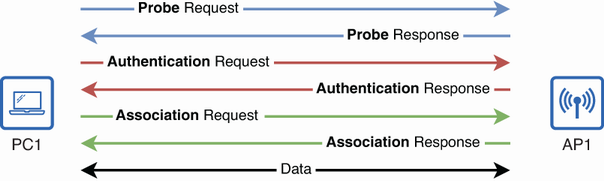
The association-process figure shows the probe request and response exchange used to discover an access point before authentication and association. section 19.1.2
