Passive scanning discovers nearby wireless networks by having a client listen for beacon messages that access points periodically transmit to advertise each basic service set (BSS). section 19.1.2
The discovery and connection sequence works as follows:
- The client receives beacons and identifies available access points and the SSIDs they advertise. section 19.1.2
- The client can conserve battery power because it listens instead of continually transmitting probe requests, but discovery may take longer. section 19.1.2
- After discovery, the client must authenticate and associate with the access point before sending or receiving wireless data. section 19.1.2 section 19.3
- Unlike passive scanning, active scanning sends probe requests and receives probe responses, usually discovering access points more quickly. section 19.1.2
Everyday Wi-Fi discovery
When a phone or laptop displays available cafe or home SSIDs, it has discovered nearby access points through received beacons, probe exchanges, or both. section 19.1.2
Figure 19.3 The client association process. The probe request/response exchange allows PC1 to discover AP1. PC1 then authenticates and associates with AP1.
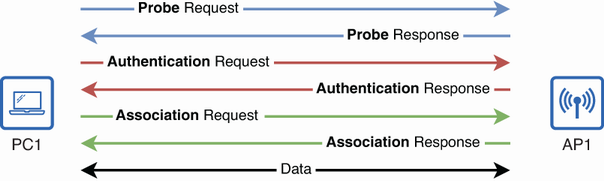
Trace discovery through the client association process: beacon-based or probe-based discovery precedes authentication and association with the access point. section 19.1.2
