liveBook · Manning

Beacon message

As explained in Acing the CCNA Exam: Volume 2 Advanced Networking and Security

A beacon message is a periodically transmitted 802.11 management frame that advertises a wireless access point's basic service set.

A beacon message is a periodically transmitted 802.11 management frame that advertises an access point’s basic service set (BSS). Clients can discover nearby APs by listening for beacons, a process called passive scanning. section 19.1.2 section 19.3

Beacon-based discovery has these operational characteristics:

  • Passive scanning can conserve client battery life but may take longer than active scanning with probe requests and responses. section 19.1.2
  • Discovering an AP does not authorize data transfer; the client must authenticate and associate before sending or receiving wireless traffic. section 19.1.2 section 19.3

Wi-Fi discovery

When a phone displays unfamiliar SSIDs at a café or in a neighboring home, it may have discovered APs by receiving their beacons. section 19.1.2

Figure 19.3 The client association process. The probe request/response exchange allows PC1 to discover AP1. PC1 then authenticates and associates with AP1.
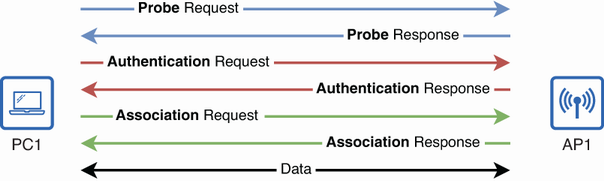
Trace beacon-based discovery alongside probe exchange, authentication, and association in the client association process. section 19.1.2

How Acing the CCNA Exam: Volume 2 Advanced Networking and Security covers it

How deep it goes
Defines periodic advertisement and contrasts passive scanning with active scanning, but does not detail beacon fields or timing.
Examples
Uses phone and laptop Wi-Fi lists at cafés, homes, and neighboring networks as discovery examples.
What it assumes
Assumes basic awareness of wireless clients and access points while defining passive scanning and the association sequence.
What you can do after
Evaluate how passive scanning discovers APs and why authentication and association still precede wireless data transfer.
How it connects
Connects passive scanning with access points, basic service sets, probe requests, probe responses, authentication, and association.

Related concepts

This explainer was generated by Manning's knowledge graph from the text of Acing the CCNA Exam: Volume 2 Advanced Networking and Security. The section links point to the parts of the book it draws on.