A producer is a concurrent component that creates values and places them into a shared data structure, commonly a bounded queue. Multiple producers may run simultaneously, so entering a value is a critical region that must be synchronized. section 16.4 section 16.0
A producer operating with a bounded queue typically follows this sequence:
- Acquire the queue’s condition object before inspecting or changing the shared queue. section 16.4.1
- Wait while the queue is full, releasing the condition object so another thread can proceed. section 16.4.1
- Enter the value, then notify waiting consumers when the queue has become not empty. section 16.4
- Repeat production for its assigned turns and coordinate completion with an end sentinel for consumers. section 16.4.2
Python bounded-queue producer
A Producer creates several threads, each running _produce(). Each thread generates values and calls _enter(), which acquires queue.condition, waits while queue.is_full(), enters the value, and signals the condition when appropriate. A BoundedQueue supplies enter(), size(), is_empty(), is_full(), and condition operations; consumers remove values concurrently.
Figure 16.9 The producer and consumer threads each attempt to acquire queue.condition at the top of its loop. The condition object synchronizes the producer and consumer threads. The producer threads loop to enter values into the shared bounded queue, and the consumer threads loop to remove values from the queue. A producer thread cannot enter a value into the queue when the queue is full. A consumer thread cannot remove a value from an empty queue.
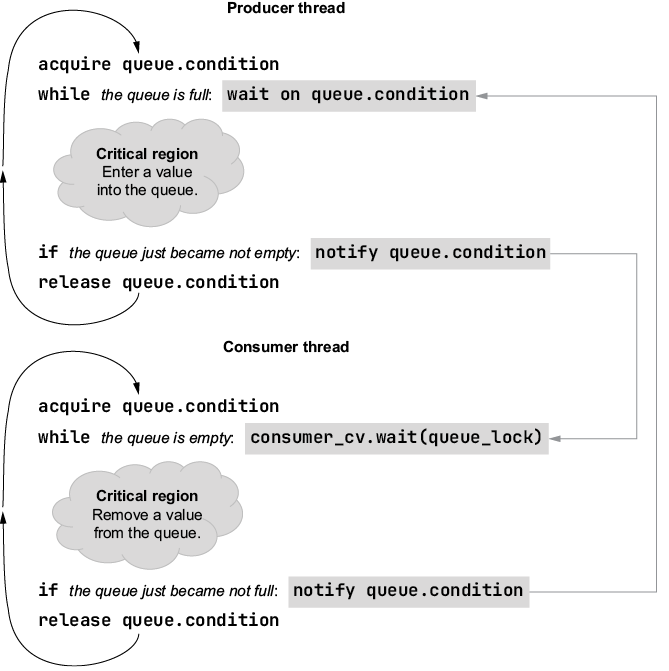
Trace how producers and consumers acquire the same condition, wait for queue state changes, recheck conditions, and enter or remove values safely. section 16.4.1







