Product strategy clarifies what a product should accomplish and how it can differentiate. For IT decisions, its value is practical: it turns broad business ambitions into questions about which capabilities create business impact and what a system should optimize for. section 10.1.2 section 10.4
From advantage to strategic IT candidate
Chegg’s 2010 strategy named hard-to-copy advantages, including a dataset linking courses to textbooks and content, personalization built on that data, and a homework-help platform. These capabilities were candidates for strategic IT because they could support differentiation. Other advantages, such as high-volume textbook purchasing and a campus-wide brand, show why the whole strategy matters: not every advantage is software. section 10.1.2
Do not label software strategic merely because it is built in-house or appears at a particular stage on a Wardley Map. Use the map to find candidates, then examine how each component contributes to the strategy and creates business impact. section 10.1.2
Resolve the goal before choosing the model
At Vinted, competing models for product categories exposed different beliefs about product strategy. The team could not settle boundaries and team structures by debating models alone. EventStorming and context mapping helped reveal the disagreement; Core Domain Charts helped them examine the options in a wider strategic context, including their complexity and potential differentiation. section 10.4
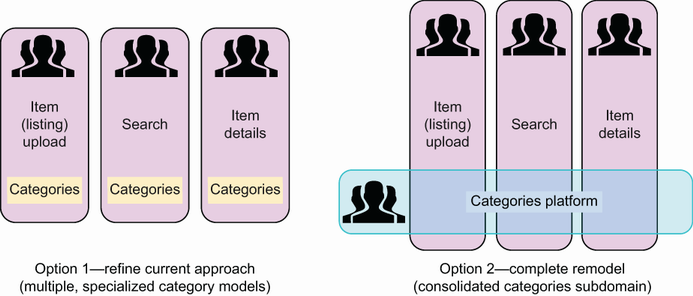
The competing category models make the architectural choice visible: selecting a model also means deciding which product goals it should serve. section 10.4
When a modeling discussion stalls, ask what each option helps the product accomplish, what complexity it introduces, and which long-term ambition it supports. Align on those aims before committing to boundaries, code structures, or team structures. section 10.4
