A taxonomy classifies domain concepts or entities into categories and subcategories. In search, it injects domain understanding beyond basic keyword matching. section 2.4 section 1.3
Taxonomy differs from related knowledge-modeling techniques: synonyms provide replacement terms, ontologies map relationships between types, and knowledge graphs instantiate those relationships with actual entities. Synonyms and alternative labels can map to taxonomy entries. section 2.4
Search teams use taxonomies as part of a progressively richer relevance system:
- Add taxonomy-based domain understanding after establishing basic keyword search and manual relevance tuning. section 1.3
- Combine taxonomies with synonym lists, known entities, and domain-specific business rules to improve relevance. section 1.3
- Use taxonomy as a foundation for richer query interpretation involving query classification, semantic parsing, and knowledge graphs. section 2.4 section 1.3
Figure 2.12 Levels of domain-specific knowledge modeling. Knowledge graphs extend ontologies, which extend taxonomies. Synonyms extend alternative labels and map to entries in taxonomies.
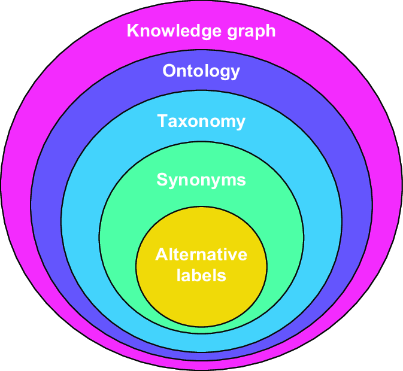
Shows taxonomy as the foundation that ontologies extend, while knowledge graphs extend ontologies; synonyms and alternative labels connect into taxonomy entries. section 2.4

