A product taxonomy is a shared language for describing architecture through products, business outcomes, customer outcomes, domains, capabilities, and responsible organizational units. It connects business architecture with software architecture and helps shape empowered product teams around sustainable flow and key outcomes. section 6.0 section 6.5
A taxonomy can include adaptable building blocks such as:
- Products used by external customers or internal employees. section 6.5
- Platforms that provide internal capabilities to multiple products, including development platforms. section 6.5
- Hierarchical domains and subdomains, described at progressively granular scope levels. section 6.5
- Value streams representing the activities used to discover and deliver product enhancements. section 6.5
Design only enough detail to support the immediate objective, such as defining a modernization slice deliverable within three to six months. Avoid both superficial maps that hide complexity and elaborate taxonomies that delay value. section 6.2.2 section 6.5
Treat the taxonomy as an evolving socio-technical design. Distribute decision responsibility to product and technology leaders, balance autonomy with standardization, publish updates regularly, and let teams raise concerns about unclear ownership or excessive coordination. section 6.2.3 section 6.2.4
Mapping a first modernization slice
Begin with a listening and mapping tour involving diverse stakeholders. Sketch the higher levels of the future taxonomy, identify candidate slices, compare their costs, benefits, risks, and complexity, then use a kickstarter workshop to select an option and plan delivery. Form teams and schedule learning before or during delivery; a first slice may begin soon after selection and finish within roughly three to six months. section 6.3 section 16.2.1
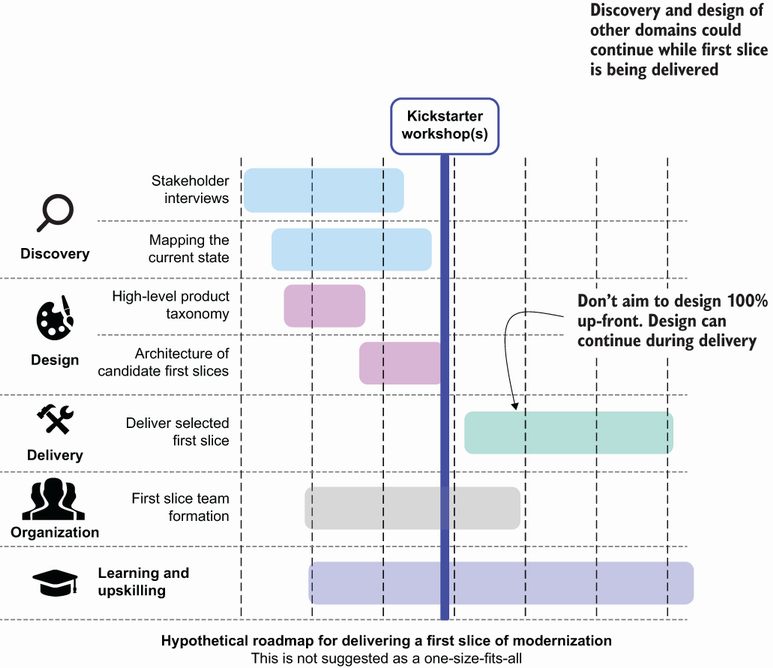
Use the hypothetical roadmap to visualize how listening, taxonomy sketching, option selection, team formation, learning, and first-slice delivery can fit into an evolutionary modernization path. section 16.2.1

